
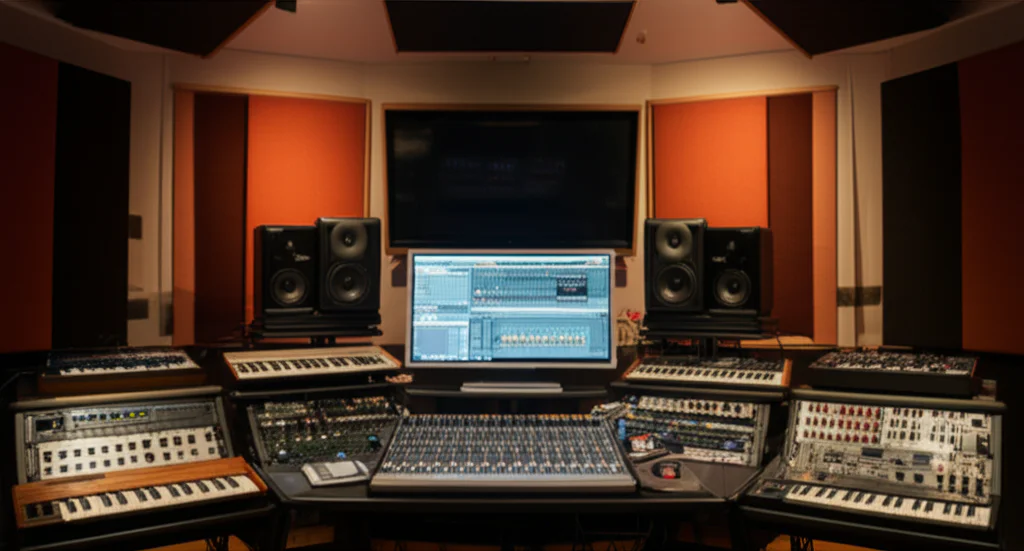
The best sound design Reason Refills are the ones that give you inspiring, editable sounds—not just a mountain of presets. Start with a library that fits your style and Reason setup, then reshape its patches, samples, and Combinators until they feel like yours.
We’ve opened a session for one atmospheric pad and ended up resampling it into a rumbling transition, a pulsing bass, and a texture that sounded suspiciously like a spaceship with plumbing problems. That’s the fun of a good ReFill: it can be a ready-to-play instrument, a box of raw material, or both. Our guide covers 30 sound categories, what to look for, compatibility, installation, and ways to turn presets into original sounds.
Key Takeaways
- Choose for the job: Match a ReFill to the sounds you need, whether that’s ambient drones, cinematic impacts, electronic bass, or playable drums.
- Check compatibility first: Confirm your Reason version, required Rack Extensions, file format, and license terms before installing.
- Audition in context: A preset that sounds impressive solo may crowd your track; listen alongside your drums, chords, or picture.
- Make presets your own: Layer, resample, automate, and edit patches instead of treating them as finished sounds.
- Keep your library organized: Back up ReFills and track device dependencies so older projects can reopen reliably.
Table of Contents
- ⚡ Quick Tips and Facts: Sound Design Reason Refills
- 🎛️ Reason Refills Explained: What They Are and How They Work
- Refills, Rack Extensions, REASON Studios, and VST Plug-ins Compared
- Refill Formats, Compatibility, and File Sizes
- 📚 From Factory Sound Banks to Modern Reason Refills
- 🌌 30 Best Reason Refills for Sound Design and Music Production
- 1. Ambient and Cinematic Soundscape Refills
- 2. Dark Ambient and Horror Texture Refills
- 3. Atmospheric Pad Refills
- 4. Evolving Synth and Morphing Texture Refills
- 5. Analog Synth Bass Refills
- 6. Modern Electronic Bass Refills
- 7. Drum and Percussion Refills
- 8. Acoustic Drum and Breakbeat Refills
- 9. Hip-Hop and Boom-Bap Refills
- 10. Trap and 808 Refills
- 11. House and Techno Refills
- 12. Trance and Progressive Refills
- 13. Drum and Bass Refills
- 14. Dubstep and Heavy Bass Refills
- 15. Lo-Fi and Dusty Sample Refills
- 16. Vintage Keyboard and Piano Refills
- 17. Orchestral and Hybrid Cinematic Refills
- 18. Choir and Vocal Texture Refills
- 19. Guitar and Plucked Instrument Refills
- 20. World Instrument and Ethnic Texture Refills
- 21. Field Recording and Foley Refills
- 22. Noise, Impacts, and Risers
- 23. Glitch and Experimental Sound Design Refills
- 24. Modular and Eurorack-Inspired Refills
- 25. Malström and Wavetable Synth Refills
- 26. Thor and Subtractor Synth Refills
- 27. Europa and Grain-Inspired Synth Refills
- 28. Kong Drum Designer Refills
- 29. Combinator Performance and Multi-Instrument Refills
- 30. All-in-One Genre and Production Refills
- 🔍 How to Choose the Right Reason Refill
- Match Refills to Your Genre, Instruments, and Workflow
- Evaluate Sound Quality, Variety, and Preset Depth
- Check Compatibility Before You Buy or Download
- Free vs. Paid Reason Refills
- 🧰 Installing, Browsing, and Managing Reason Refills
- Install a Refill in Reason
- Find Refills in the Reason Browser
- Organize, Relocate, and Back Up Your Refill Library
- 🎹 Using Reason Refills in Real Sound Design Sessions
- Layer Refill Sounds for Original Textures
- Resample, Process, and Transform Presets
- Build Combinators and Custom Patch Libraries
- Use Refills in Reason as a DAW or Rack Plug-in
- 🛠️ Troubleshooting Reason Refill Problems
- Reason Cannot Find or Open a Refill
- Missing Samples and Broken Patches
- Version, Authorization, and Operating-System Issues
- Slow Browsing and Large Refill Libraries
- ⚖️ Reason Refills vs. Rack Extensions, VSTs, and Sample Packs
- 📌 Key Takeaways for Building a Better Refill Library
- ✅ Conclusion
- 🔗 Recommended Links
- ❓ FAQ
- What is a Reason Refill?
- Are Reason Refills free?
- Where do I install Reason Refills?
- Do Reason Refills work in every version of Reason?
- Can I use Reason Refills in another DAW?
- What is the difference between a Refill and a Rack Extension?
- Can I create my own Reason Refill?
- How do I fix missing sounds in a Refill?
- 📖 Reference Links
Quick Tips and Facts: Sound Design Reason Refills
If you’re exploring Reason Refills for sound design, start with the sound you need—not the biggest library you can find. A focused pack of expressive patches can inspire more music than a mammoth folder you never open. 🎛️
| Quick fact | What it means for your workflow |
|---|---|
A ReFill commonly uses the .rfl file format |
It can package samples and Reason-ready content in one library. What it contains depends on the publisher. |
| A ReFill can include more than audio samples | Libraries may contain instrument patches, loops, Combinators, and other Reason content. |
| Compatibility depends on the content inside | A sample may load in an older project, while a patch that uses a newer device—or a required Rack Extension—may not. Check the developer’s system requirements and Reason Studios’ support pages. |
| Preset count doesn’t measure usefulness | Listen for sound quality, playable range, variation, and whether the sounds suit your actual tracks. |
| Sound design starts after you load a patch | Change the modulation, effects, envelopes, routing, or sample material. Treat presets as raw material, not finished answers. |
| Ambient patches can be CPU-intensive | Complex granular instruments and effect chains can tax a session. Record or freeze a track if playback becomes sluggish. |
| Licensing matters | Read the publisher’s terms before using a library in commercial work, and don’t redistribute raw samples or patches unless the license explicitly permits it. |
Our quick-start advice: audition the sound with your drums, chords, or picture—not solo at heroic volume. A patch can sound enormous on its own and vanish in a mix. We’ve all met that patch.
Reason Refills Explained: What They Are and How They Work
A Reason ReFill is a sound library designed for use in Reason, but “sound library” can undersell what a good one does. A ReFill may combine samples, synth patches, drum kits, loops, and pre-built instrument setups. Some include Combinator patches that connect instruments and effects into a playable, tweakable rack.
Think of a ReFill as a toolbox: one library might give you clean multisamples for a sampler, while another hands you a complicated cinematic machine with modulation already wired up. The first is flexible building material; the second is a head start with a few knobs begging to be turned.
What can a Reason ReFill contain?
| Content type | Common Reason use | What to check |
|---|---|---|
| One-shot samples | Load into Kong, Redrum, or a sampler for custom patterns | Tuning, tails, recording quality, and permitted uses |
| Multisamples | Play sampled instruments across a keyboard or velocity range | Key range, velocity layers, and consistency between notes |
| Synth patches | Use with devices such as Thor, Subtractor, Europa, or Malström | Required device and Reason version |
| Combinator patches | Play or control several instruments and effects as one rack setup | Device dependencies, performance controls, and CPU load |
| Lops and sliced material | Build rhythmic parts or resample fragments into new patterns | Tempo, loop length, and editing flexibility |
| Effects patches | Start from a prepared effect chain or processing setup | Required devices and how much control the patch exposes |
| Demo songs or examples | See how the publisher arranged or used the sounds | Whether all referenced devices are included |
The actual contents vary by ReFill. A library’s title alone won’t tell you whether it’s mostly playable instruments, loops, or designed sound effects, so read the product description and listen to the demos.
ReFills, Rack Extensions, Reason, and VST plug-ins compared
These products solve related but different problems. A ReFill supplies content; a Rack Extension or plug-in supplies an instrument or processor.
| Format | What it provides | Best suited to | Potential drawback |
|---|---|---|---|
| Reason ReFill | Samples, patches, loops, and other packaged Reason content | Expanding Reason’s sound library and browser-based workflow | May depend on devices or versions you don’t have |
| Rack Extension | A Reason instrument or effect | Adding a specialized device to the Reason rack | Typically requires the specific extension |
| VST/AU plug-in | An instrument or effect usable in compatible DAWs | Moving between DAWs or accessing a specific third-party tool | Presets and projects may not transfer seamlessly between systems |
| Sample pack | Audio files, often WAV or AIFF | Working across DAWs or building custom instruments | Usually needs more manual mapping and setup |
The Reason Rack Plugin brings Reason’s rack into compatible DAWs, but that doesn’t automatically make every ReFill a standalone plug-in. Check the current product documentation for your version and host.
ReFill file formats, compatibility, and dependencies
A .rfl file is a container format, but the content inside determines how you use it. A ReFill built around samples may behave differently from one whose patches depend on a particular instrument or Rack Extension.
Before downloading or buying, check:
- Supported Reason version: Newer patches may rely on devices not present in older releases.
- Required Rack Extensions: A patch may open with missing-device warnings if you don’t own the required extension.
- Operating system and installer instructions: Follow the publisher’s current guidance rather than relying on an old forum post.
- Library contents: Look for a breakdown of patches, samples, loops, and included demos.
- License terms: Confirm how the sounds may be used in released music, film, games, or other commercial work.
- Backup and portability: Keep the original download and note which projects depend on it.
Reason’s official help center is the safest starting point for version-specific installation and compatibility guidance. For more practical production workflows, browse our music production techniques guides.
From Factory Sound Banks to Modern Reason Refills
Reason’s sound-library ecosystem has grown from banks of patches and samples into a broad mix official content and independent sound design. The modern ReFill can be a collection of classic drum-machine hits, a Combinator-based performance instrument, or an evolving soundscape designed around a specific Reason device.
That history explains why ReFills vary so much. Some are closer to a sample pack in a Reason-friendly wrapper; others are carefully programmed instruments whose value lies in their modulation, routing, and controls. The key question isn’t “How many gigabytes?” It’s what can you make with it?
A useful starting point is Reason’s included content. Then add a specialized library when you can describe the gap: “I need expressive drum breaks,” “I want playable evolving pads,” or “My film cues need less familiar textures.” As we say in the studio, the most inspiring ReFill isn’t necessarily the biggest one.
30 Best Reason Refills for Sound Design and Music Production
There isn’t one universal “best” ReFill. The right choice depends on your genre, workflow, current Reason version, and whether you want raw samples or ready-to-play patches. The recommendations below draw on publisher descriptions and the sound-design use cases covered in our Reason ReFill guide.
Important: Product availability, names, contents, and compatibility can change. Verify the current listing from the publisher before downloading or purchasing. A few entries are categories or sound-library lines rather than a promise that every named title is sold as a current .rfl product.
1. Ambient and cinematic soundscape Refills
Ambient libraries are useful when you need drones, evolving pads, slow-motion textures, or atmospheric transitions. Luftrum is a strong name to investigate for atmospheric sounds; its official site describes its sound libraries and products at Luftrum. Check the specific product page format and Reason compatibility before assuming a library is a ReFill.
For Reason-oriented cinematic design, look for patches with useful modulation and hands-on controls—not just long reverb tails. Loopmasters also carries sound libraries across ambient and cinematic styles, though each product’s format varies.
Best for: scoring, ambient music, intros, transitions, and textures that need to evolve across a cue.
2. Dark ambient and horror texture Refills
Dark drones, uneasy tonal beds, and irregular mechanical layers can help build tension without leaning on the same stock “spooky riser” every time. Explore Reason-ready sound design from Tom Pritchard Sound Design and cinematic collections from established sample publishers such as Loopmasters.
For horror scoring, listen for control over movement. Can you alter the pitch, density, filter, or rhythm? A single ominous drone is a mood; a drone that changes as the scene tightens is a storytelling tool. 🕯️
3. Atmospheric pad Refills
A good pad library should give you more than one giant, slow-attack chord. Look for velocity or modulation response, a playable range that doesn’t collapse at the edges, and patches that leave room for dialogue or lead parts.
New Lops has produced Reason-focused sound libraries; check its official site for current products and formats. For broader synthesizer sound design, Luftrum is another worthwhile source to explore.
4. Evolving synth and morphing texture Refills
Evolving patches are built around change: modulation, layered oscillators, sample movement, filter motion, or effects that respond over time. The musical benefit is obvious in ambient and cinematic work, but these patches can also add motion to intros, breakdowns, and held notes in electronic arrangements.
Audition long enough to hear the patch change. A flashy first second can hide a static next minute. We often map a MIDI controller’s Mod Wheel to a filter, effect send, or modulation depth so a pad can follow the arrangement rather than sit there like a very expensive wallpaper sample.
5. Analog synth bass Refills
For analog-style bass, look for patches with clearly defined envelopes, stable low end, and enough midrange character to translate on smaller speakers. PinkNoise Studio has published synth-focused sound libraries; check its official product information for the current format and requirements.
You don’t need a dozen layers to make a bass line work. Start with the musical role—sub weight, punch, or growl—then choose a sound that supplies it. Our creative bass sound-design guide walks through that approach in more detail.
6. Modern electronic bass Refills
Modern bass libraries may include clean subs, distorted mid-bass, animated patches, and playable Combinators. Look for separate control over the low foundation and the character layer. If the whole patch gets wider or more distorted when you turn one knob, check whether the sub stays stable in mono.
A practical recipe: use one sound for the fundamental, another for bite, and add a third only if the arrangement truly needs more attack. More layers can mean more phase problems, not more power.
7. Drum and percussion Refills
Goldbaby is known for sampled drum-machine sounds and characterful production libraries. Its official site is the place to check current products and formats. Some Goldbaby libraries are sample packs rather than Reason ReFills, so confirm what you’re downloading.
For Reason-native drum use, choose libraries with well-organized one-shots and clear mappings for devices such as Kong or Redrum. Audition kick, snare, and hats together: isolated drum sounds can be lovely, but a kit is only useful if its pieces cooperate.
8. Acoustic drum and breakbeat Refills
If you want live-feling drums, search for performances with velocity variation, multiple hits, and usable fills—not just a loop that sounds great once. The Loop Loft specializes in recorded loops and instrument performances; its official site lists current libraries and formats.
Breaks are excellent for texture and groove, but a loop can fight your arrangement. Slice it, change the accents, or use its individual hits to build a new pattern. A loop is a suggestion, not a contract.
9. Hip-hop and boom-bap Refills
For boom-bap, prioritize drum character, manageable sample tails, and useful combinations of kicks, snares, and breaks. Goldbaby and The Loop Loft are useful publishers to explore for character-rich drums and performance-based material.
A good hip-hop library should leave space for your own swing and arrangement choices. If every loop already sounds like a finished beat, it may be less useful than a smaller collection of flexible hits.
10. Trap and 808 Refills
Trap-oriented packs often include 808s, sharp percussion, hats, and transition effects. ModeAudio publishes electronic sound libraries and sample packs; check its official site for the current products and format details.
For 808s, check tuning, tail length, and how the sample behaves across notes. A bass sample that sounds enormous in its root key may become thin or unwieldy when pitched far from that range. Keep a clean backup before adding distortion, and test the result against the kick.
11. House and techno Refills
House and techno libraries are most useful when they offer flexible drum hits, rhythmic loops, synth patches, and transitions that fit your tempo range. Reason Studios’ official sound libraries are a sensible first stop for Reason-native content; check the Reason Studios shop for current offerings.
For techno, search for focused low end and motion. For house, round bass, crisp percussion, and musical chord stabs are often more useful than extreme sound effects. The genre label helps you browse, but your ears should make the final call.
12. Trance and progressive Refills
Trance and progressive productions often rely on playable leads, evolving pads, plucks, arpeggios, and risers. Nucleus SoundLab and Luftrum are publishers to investigate for synth-oriented libraries; verify the product format and device requirements at their official sites.
A practical test: hold a chord, move the Mod Wheel, and listen for a meaningful change. If the patch only gets louder, it may still be useful—but it’s not much of a performance control.
13. Drum and bass Refills
Drum and bass benefits from tightly controlled bass sounds, clean transient samples, and breaks that can be chopped without losing their punch. Search specialized publishers such as Loopmasters and Goldbaby for suitable source material.
For bass design, keep the deepest layer simple and centered, then put movement and distortion on the upper harmonics. That separation helps retain low-end definition while still letting the midrange snarl.
14. Dubstep and heavy bass Refills
Heavy bass libraries can inspire growls, wubs, and aggressive midrange textures. Nucleus SoundLab has made synth-focused Reason content, while Loopmasters offers a wide range of electronic sample libraries. Confirm that a specific product is actually a Reason ReFill rather than a WAV-only pack.
If a patch uses lots of modulation and effects, watch CPU use. Render or freeze it once the sound is right, then keep the original instrument track muted as your editable source.
15. Lo-fi and dusty sample Refills
For dusty hip-hop, lo-fi, or downtempo production, look for textured drums, vinyl-like noise, imperfect loops, and samples with controlled dynamics. Goldbaby is a good publisher to investigate for characterful sampled material, while Loopmasters offers broad genre coverage.
Don’t treat noise as an automatic shortcut to “vintage.” A little texture can make a sound feel lived-in; too much can make the mix feel like it was left in a drawer.
16. Vintage keyboard and piano Refills
Keyboard libraries vary widely in realism and playability. For sampled pianos, check velocity layers, sustain behavior, and whether the instrument remains balanced across the keyboard. For vintage synths, listen for useful patch variation rather than relying on a famous model name.
Reason’s official store is the best place to verify current native instruments and sound banks. If a publisher advertises piano sounds as a ReFill, check the minimum Reason version and whether the patches need a particular sampler.
17. Orchestral and hybrid cinematic Refills
For sketching and hybrid scoring, orchestral ReFills can provide quick access to strings, brass, percussion, and layered patches. ProjectSAM and IK Multimedia publish orchestral and cinematic libraries, but product formats differ; check the ProjectSAM and IK Multimedia sites for current specifications.
A ReFill can be useful for fast mock-ups, but don’t assume a compact library will replace a dedicated orchestral sample platform. Evaluate articulations, dynamics, and playability against the needs of your score.
18. Choir and vocal texture Refills
Choirs and vocal textures can add a human edge to pads, transitions, and cinematic cues. Check whether a library includes sustained vowels, short articulations, phrases, or processed textures; those are different tools.
For film and game work, watch licensing terms closely. A “vocal sound library” may include commercially usable samples, but the specific license—not the product category—sets the rules.
19. Guitar and plucked-instrument Refills
Guitar libraries range from simple strums and riffs to detailed multisampled instruments with articulations. Indiginus makes instrument libraries; check its official site for product formats and supported software.
A guitar patch can be great for sketching, layering, or stylized production. For exposed realistic performances, articulation changes and phrasing matter as much as the sample quality. A-List Acoustic Guitarist is another Reason instrument to check through Reason Studios.
20. World-instrument and ethnic-texture Refills
World-instrument collections can add distinctive timbres and percussion, but they need respectful, accurate labeling and clear provenance. Sonic Reality and other specialist publishers have offered world-instrument libraries; check their current product pages for availability, format, and instrument details.
We recommend listening for tuning, performance style, and sample range before buying. “Exotic” is not a musical description; identifying the instrument and how it was recorded is much more useful.
21. Field recording and Foley Refills
Field recordings can supply wind, rooms, machines, water, footsteps, and other environmental material for scoring and sound design. Publishers such as Loopmasters carry sound-effect and sample libraries, but confirm whether a pack is a ReFill or standard audio files.
For location-based work, check recording details and licensing. A natural-sounding atmosphere can be more convincing than a heavily processed synth, especially when it gives the cue a sense of place.
22. Noise, impacts, and risers
Impacts, whoshes, boms, and risers are useful for transitions and cinematic emphasis. New Lops and Loopmasters are places to search for sound-design libraries, with product formats varying by release.
The most useful transition sounds are often the ones you can edit. Look for separate components, tails you can trim, and clear pitch or tempo information where available. A long riser is not automatically dramatic; timing is the drama.
23. Glitch and experimental sound-design Refills
Glitch libraries can add broken rhythms, granular artifacts, digital noise, and irregular movement. For a Reason-native sound-design workflow, seek patches with editable modulation or sample mapping rather than only bounced loops.
Try cutting a short sound into a sampler, reversing fragments, and changing the rhythm. That way, the library supplies raw material while your arrangement supplies the identity.
24. Modular and Eurorack-inspired Refills
Modular-inspired sound libraries often feature drones, feedback, unstable pitch, and complex modulation. Check whether the patches are built with Reason’s internal devices or depend on third-party Rack Extensions.
The best patches expose a few musically useful controls. A rack with twenty devices may be impressive to inspect; a rack where one knob creates a controlled rise in tension is often more practical.
25. Malström and wavetable-synth Refills
Malström and wavetable-oriented patches can provide moving textures, metallic tones, and distinctive synth timbres. Before loading an older library, verify that the patch is designed for a device available in your Reason installation.
Older patches may still be useful, but newer devices or routing setups can create compatibility surprises. When in doubt, audition the demo and check the publisher’s requirements rather than relying on the patch name.
26. Thor and Subtractor synth Refills
Thor and Subtractor patches can be useful for basses, leads, pads, and classic electronic tones. Their advantage is that you can often inspect and modify the synthesis rather than treating the sound as a fixed recording.
Open the patch and learn how it works. Change one thing at a time: oscillator, filter, envelope, or modulation. That small habit turns browsing into sound-design practice.
27. Europa and granular-synth Refills
Europa and granular-oriented libraries can deliver modern wavetable tones, sampled textures, and complex evolving sounds. The featured video in this article’s Granular Maneuvers demonstration highlights a SKP Sound Design ReFill built for Reason’s Grain Sample Manipulator, with cinematic patches such as “Abandoned Facility,” “Cavern Bubbles,” and “Pier Light.”
The video reviewer praises the library as “remarkably good” and says it is “almost better than the patches that Propellerhead put in.” That’s one producer’s listening impression, not a measured comparison, but the demonstration is useful for hearing the range from ambiences to rhythmic patches. The reviewer also recommends freezing or recording CPU-heavy tracks—a practical tip when granular synthesis starts turning your session into a slideshow.
28. Kong Drum Designer Refills
Kong-focused ReFills are useful when you want drum hits mapped to pads and ready for performance or sequencing. Look for clear pad organization, editable one-shots, and well-balanced levels across the kit.
For a more natural kit, check whether the library has velocity variation or multiple takes. For electronic drums, sound quality and easy swapping may matter more than realistic articulation.
29. Combinator performance and multi-instrument Refills
Combinator patches can bundle instruments and effects into one playable setup. Their real strength is not just convenience: they can make several devices respond together to a control surface or MIDI knob.
When browsing, inspect the controls. A Combinator with mapped filter, reverb, and modulation parameters can be an expressive instrument; a patch with impressive internal complexity but no useful controls can be harder to perform.
30. All-in-one genre and production Refills
All-in-one packs can provide drums, synths, loops, and effects for a particular style. Loopmasters and other established sound publishers offer broad libraries, while Reason’s official store is a useful source for Reason-ready content.
These packs are convenient, but check whether they contain the material you actually use. A pack may advertise hundreds of files while offering only a handful of useful instruments. Preview the contents, confirm the format, and remember: quality over quantity, always.
How to Choose the Right Reason ReFill
A good ReFill fits your musical problem, works in your setup, and gives you room to make the sound your own. Before you commit, check the preview, technical details, supported devices, and license.
Match Refills to your genre, instruments, and workflow
Begin by naming the job:
- Need playable bass? Prioritize stable low end, useful envelopes, and the ability to edit notes.
- Need ambient atmosphere? Look for evolving patches, drones, and controls for modulation and space.
- Need drums? Decide whether you want one-shots, loops, multisampled kits, or all three.
- Need cinematic impacts? Check for editable tails and layers, not just a single finished effect.
- Need quick ideas? Combinators and well-organized preset banks may save setup time.
- Need cross-DAW portability? A standard sample pack may be easier to share than a device-dependent patch library.
Our musicians and sound designers often ask one simple question before auditioning: What is this sound supposed to do in the arrangement? That prevents “I bought a pack because the demo was loud” syndrome.
Evaluate sound quality, variety, and preset depth
Listen to the actual demo, then test individual patches when possible. Look for:
- Clean edits: No accidental clicks, abrupt cuts, or unexplained noise.
- Useful variation: Multiple articulations, velocities, or alternate hits when the instrument calls for them.
- Playable range: Notes should retain a believable character across the keyboard.
- Practical controls: Modulation and effects should be accessible, especially on performance patches.
- Mix-ready balance: Sounds should be usable without extreme corrective processing.
- Honest descriptions: A publisher should state the required software, device dependencies, and included formats.
Don’t confuse loudness with quality. Match levels between demos when comparing products, and hear the sound against a track if possible. For more on listening and production decisions, see our plugin recommendations.
Check compatibility before you download or buy
Use this checklist:
- Check your Reason version. Confirm the publisher supports your installed release.
- Identify required devices. Look for required Rack Extensions or other software.
- Confirm the file format. Is it an
.rfl, WAV/AIFF sample pack, plug-in preset library, or a mixture? - Read installation guidance. Follow the vendor’s steps for your operating system.
- Review license terms. Confirm permitted commercial use and restrictions on redistribution.
- Save the product page and support details. That information helps later if a project loses track of its content.
Reason Studios’ support center is a good source for Reason-specific questions. For device and sound-library comparisons beyond ReFills, browse our hardware vs. software articles.
Free vs. paid Reason Refills
Free libraries can be excellent, especially for experimentation and learning. Peff.com has long shared Reason resources and ReFills; check its official site for current downloads. Jiggery-Pokery also offers Reason-related sound content through its official site. Availability and compatibility may vary.
| Free libraries | Paid libraries |
|---|---|
| ✅ Low-risk way to explore a sound or device | ✅ Often include deeper programming, organization, or support |
| ✅ Useful for learning patch construction | ✅ May offer specialized recording or performance detail |
| ❌ May have limited documentation or updates | ❌ Product description still needs checking; price doesn’t guarantee fit |
| ❌ License terms can still restrict redistribution | ❌ Some products depend on extra devices or software |
Free doesn’t mean unrestricted. Read the license, keep the source files, and don’t assume that a free download permits you to redistribute the samples in another pack.
Installing, Browsing, and Managing Reason Refills
An organized library saves time and keeps projects portable. Exact installation steps can change between Reason versions and operating systems, so use the publisher’s instructions and Reason Studios’ official help center as your reference.
Install a ReFill in Reason
A common installation workflow is:
- Download the ReFill from its publisher or an authorized distributor.
- Keep the original file untouched in a backup folder.
- Follow the supplied installer or Reason’s instructions. Some publishers support opening a ReFill file directly; others provide a different installation process.
- Open Reason and check the Browser. Confirm the library is visible and that its categories appear as expected.
- Load a few patches. Verify that the necessary devices are present and samples resolve correctly.
- Save a test project. Close and reopen it to confirm the patch remains available.
Don’t rely one fixed folder path copied from an old tutorial. Locations and installation behavior can differ by Reason release and operating system.
Find Refills in the Reason Browser
Use descriptive folders and favorites rather than scrolling through one enormous list. Organize by either sound role or publisher:
01_Drums02_Bass03_Pads_and_Drones04_Cinematic_FX05_Vocal_and_Organic06_Experimental
Then audition sounds in context. For faster performance browsing, see our performance techniques guides and consider mapping a few useful patch controls to a MIDI controller.
Organize, relocate, and back up your ReFill library
Treat your ReFill folder like project media:
- Keep a master library on a reliable drive.
- Back up original downloads and license information.
- Avoid renaming files or folders if a publisher’s installer depends on their structure.
- Record required Reason versions and Rack Extensions in a notes file.
- For collaboration, verify that the recipient has the ReFill and any required devices.
- Reopen older projects after moving a library to check for missing content.
If a project uses a sound that can’t be shared, export a rendered audio version for reference while preserving the original MIDI and patch. That gives collaborators a safety net without redistributing protected source material.
Using Reason Refills in Real Sound Design Sessions
A ReFill is most valuable when it gets changed. We use patches as a starting point, then reshape them through performance, modulation, resampling, and arrangement. A library’s demo may show one path; your track can take a completely different turn.
Layer ReFill sounds for original textures
Layer with a job in mind. For example, combine:
- A low, steady drone for weight.
- A bright, granular layer for movement.
- A quiet field recording for organic detail.
- A short transient to mark a change or rhythmic pulse.
Keep the layers at different pitch ranges or roles. If two patches occupy the same frequency area, the result may become muddy instead of bigger. Pan carefully, check in mono, and use less reverb than your first instinct requests. Your future mix engineer will send a thank-you note.
Resample, process, and transform presets
Here’s a practical workflow for turning a preset into a new sound:
- Save a copy of the original patch.
- Play a short phrase or hold a note long enough to capture its movement.
- Record or bounce the result to audio.
- Trim the start and end, adding short fades if edits click.
- Load the audio into a sampler or slice it into regions.
- Change the pitch, timing, or playback direction.
- Add one or two processors—for example, filtering, distortion, delay, or reverb.
- Compare the edited sound with the original at matched loudness.
- Save the transformed result as a new patch or audio asset, while preserving the source.
In Reason, devices such as Mimic can be useful for manipulating audio material; verify device availability in your version. For more ideas, explore our music production techniques library.
Build Combinators and custom patch libraries
A Combinator is most useful when it makes a complex rack easy to play. Try this step by step:
- Choose an instrument patch with the right basic character.
- Add only the devices that solve a specific problem.
- Map a few controls—such as filter cutoff, reverb send, or modulation depth—to performance controls.
- Set sensible minimum and maximum values so a knob doesn’t turn the patch into an accidental science experiment.
- Test the mappings while playing.
- Save the Combinator with a clear name that describes its musical use.
We once took a plain sustained synth, layered a noisy texture underneath, and mapped one control to both filter movement and effects depth. The result felt alive without needing a dozen automation lanes. A few well-chosen controls beat a rack full of mystery knobs.
Use Refills in Reason as a DAW or Rack plug-in
ReFills are designed for Reason’s environment. The Reason Rack Plugin can bring Reason instruments and effects into compatible DAWs, but the exact feature set depends on the current product and host.
Before moving a project between Reason and another DAW:
- Check supported plug-in formats and your host’s compatibility.
- Confirm which Reason devices are available in your setup.
- Test whether your project can reopen with all ReFill content.
- Render essential tracks when collaborating across different systems.
- Keep MIDI and patch versions where possible so edits remain available.
For broader comparisons between rack-based and plug-in workflows, visit our hardware vs. software section.
Troubleshooting Reason Refill Problems
When a ReFill fails, the cause is often a mismatch between the library, Reason version, or required devices—not a mysterious curse from the rack. Check one variable at a time.
Reason cannot find or open a ReFill
Try this sequence:
- Confirm the file finished downloading and isn’t still compressed in an archive.
- Check the publisher’s installation instructions.
- Open Reason’s Browser and look for the library or its content.
- Restart Reason after installation if the library doesn’t appear.
- Check file permissions and drive availability.
- Search the Reason support center for guidance specific to your version.
Don’t move a library between drives while Reason is open. If the problem persists, note your operating system, Reason version, ReFill name, and any error message before contacting the publisher.
Missing samples and broken patches
A patch can appear in the Browser while its samples are unavailable. Check whether:
- The ReFill is installed or mounted as expected.
- The original sample directory has been moved or renamed.
- The patch depends on a separate library.
- The sound is a third-party device preset rather than a self-contained sample patch.
- The project was shared without the required ReFill.
If a patch contains missing files, locate the correct library or restore it from backup. Avoid downloading replacement samples from unofficial sources; they may be mislabeled, unsafe, or unlicensed.
Version, authorization, and operating-system issues
Older ReFills may work in newer Reason releases, but that’s not a blanket guarantee. A patch can rely on a device that has changed, disappeared, or isn’t installed. Conversely, newer patches may not open correctly in older releases.
Check the library’s product page, Reason’s official support documentation, and any Rack Extension requirements. For licensed products, make sure you’re signed in or authorized according to the publisher’s current instructions.
Slow browsing and large Refill libraries
Large libraries can take longer to browse, especially on slower storage or when an installation contains many deeply nested folders. To make the experience smoother:
- Store frequently used libraries on a fast, reliable drive.
- Remove duplicate downloads and obsolete versions from the active library.
- Use favorites and a smaller set of working folders.
- Freeze or bounce CPU-heavy granular patches once they’re ready.
- Keep the original project track muted when you need an editable safety copy.
If playback glitches, distinguish CPU load from disk streaming. A complex synth patch and a large sample library can create different bottlenecks, so troubleshoot accordingly.
Reason Refills vs. Rack Extensions, VSTs, and Sample Packs
The right format depends on what you need to do and where you need to do it.
| Choice | Choose it when… | Watch out for… |
|---|---|---|
| Reason ReFill | You want a library built for Reason’s browser, devices, and rack workflow | Device dependencies and version support |
| Rack Extension | You need a dedicated instrument or effect inside Reason | It is a device, not necessarily a full sound library |
| VST/AU plug-in | You work in several DAWs or need a particular instrument or processor | Presets and project settings may not transfer between systems |
| WAV/AIFF sample pack | You want audio files you can use widely across DAWs | More manual organization, mapping, and editing |
| Hardware instrument | You want tactile controls, standalone performance, or a particular physical instrument | Setup, recording, maintenance, and recall can take more effort |
A ReFill can be the quickest route to Reason-ready sounds; a plug-in may be more flexible across DAWs; a sample pack may be the most portable source material. None is automatically “better”—the winner is the one that fits your workflow and lets you finish the track. For more comparisons, see plugin recommendations and hardware vs. software.
Key Takeaways for Building a Better Refill Library
- Start with Reason’s included content, then add ReFills that solve a specific musical need.
- Check format, version, devices, and licensing before downloading or buying.
- Audition patches in context, not only in a polished product demo.
- Treat presets as starting points: edit, layer, resample, and automate.
- Prefer useful controls and sound quality over huge preset counts.
- Keep the low end simple and stable when designing bass-heavy sounds.
- Back up ReFills and document project dependencies to avoid missing content later.
- Freeze or record CPU-heavy patches when complex sound design slows the session.
- Trust official documentation for compatibility and the publisher’s license for usage rights.
The question we left hanging was whether a ReFill is just a convenient pile of sounds. It isn’t. The best ones offer playable ideas, smart routing, and raw material you can reshape—then your arrangement turns that material into something unmistakably yours.