
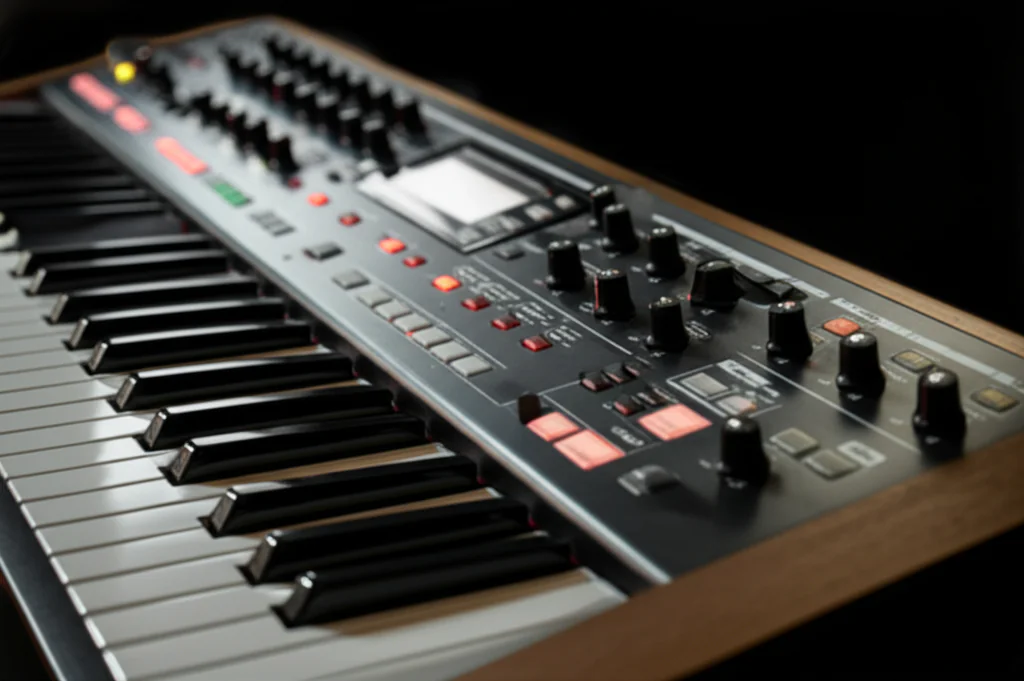

Forget the hype; the best virtual analog synthesizer isn’t a piece of vintage hardware you can’t afford, it’s u-he Diva, a plugin that sounds so authentic it makes engineers question their own ears. While we once spent a fortune chasing the “holy grail” of analog warmth, we discovered that modern DSP modeling has finally caught up, offering the soul of a 1970s Minimog with the flexibility of a digital workstation.
The truth is, you no longer need a rack full of dusty gear to create fat, squelchy basslines or lush, drifting pads. A single virtual analog synthesizer plugin can now replicate the circuit imperfections, oscillator drift, and filter resonance that defined entire genres of music.
“I remember the first time I loaded Diva and played a simple C-major chord; the sheer weight and movement of the sound made me drop my mouse. It wasn’t just a sample; it felt like the circuit was breathing right there on my screen.”
Did you know that early digital synths in the 80s were often mocked for sounding “cold” and “sterile”? Today, thanks to Zero Delay Feedback (ZDF) technology, the gap between hardware and software has virtually vanished, with some plugins even surpassing their analog counterparts in stability and polyphony.
Key Takeaways
- u-he Diva stands as the undisputed king of virtual analog synthesis, offering unmatched circuit modeling that rivals vintage hardware.
- Modern virtual analog synthesizers provide infinite polyphony and preset recall, solving the biggest limitations of physical gear.
- CPU efficiency varies wildly; while Diva demands power, alternatives like Vital and Arturia Mini V 3 offer incredible sound with lighter system loads.
- You can achieve classic analog warmth without the maintenance, drift, or massive price tag of vintage synthesizers.
👉 Shop Top Virtual Analog Synths:
- u-he Diva: Amazon | Plugin Boutique | u-he Official
- Arturia V Collection: Amazon | Arturia Official
- Native Instruments Massive X: Amazon | Native Instruments Official
- Vital (Free): Vital Official
Table of Contents
- ⚡️ Quick Tips and Facts
- 🕰️ The Evolution of Virtual Analog Synthesizers: From DSP to Digital Emulation
- 🎛️ How Virtual Analog Synthesis Works: Oscillators, Filters, and the Magic of DSP
- 🏆 Top 10 Must-Have Virtual Analog Synthesizers for Every Budget
- 🔊 Analog vs. Digital: Can a Virtual Analog Synth Really Replace Hardware?
- 🎚️ Key Features to Look for in a Virtual Analog Synthesizer
- Oscillator Types and Waveform Flexibility
- Filter Modeling: Mog, Roland, and Korg Emulations
- Modulation Routing and Envelope Generators
- Polyphony and CPU Optimization
- 🎹 Hardware Controllers vs. Software Plugins: Which Workflow Suits You?
- 🎚️ Sound Design Masterclass: Crafting Classic Patches with Virtual Analog
- 🛠️ Troubleshooting Common Issues: Latency, CPU Spikes, and Glitches
- 📚 Recommended Links for Further Exploration
- ❓ Frequently Asked Questions About Virtual Analog Synthesizers
- 📖 Reference Links and Technical Documentation
- 🏁 Conclusion: Is Virtual Analog the Future of Synthesis?
⚡️ Quick Tips and Facts
Before we dive into the deep end of the virtual analog ocean, let’s get the lay of the land. If you’re new to the game or just need a quick refresher, here are the golden nugets you need to know:
- It’s Not “Fake” Analog: Virtual Analog (VA) isn’t just sampling a recording; it’s mathematical modeling of the actual circuitry. It simulates how voltage behaves in real-time.
- The CPU is Your Power Supply: Unlike hardware where you’re limited by physical oscillators, your CPU power dictates your polyphony. More cores = more voices.
- Drift is a Feature, Not a Bug: The best VA synths (like u-he Diva) intentionally introduce oscillator drift and filter instability to mimic the imperfections of vintage gear.
- MIDI is King: One of the biggest advantages over vintage hardware is MIDI program change and preset storage. No more scribling patch notes on sticky pads!
- Hybrid is the Future: Many modern “analog” synths actually blend VA oscillators with wavetable or FM engines for maximum versatility.
Pro Tip: If you’re looking for the absolute pinnacle of analog emulation, check out our deep dive on Diva VST to see why it’s considered the “holy grail” by many sound designers.
🕰️ The Evolution of Virtual Analog Synthesizers: From DSP to Digital Emulation
The story of virtual analog synthesis is a tale of ambition, engineering, and a little bit of magic. It didn’t start with the sleek plugins we use today; it started with a desperate need to capture the warmth of analog without the bulk.
The Genesis: Roland and the D-50
Believe it or not, the first affordable attempt at “virtual” synthesis wasn’t even called that. In 1987, Roland released the D-50. While it used Linear Arithmetic (LA) synthesis (mixing PCM samples with synthesized waveforms), it laid the groundwork for the idea that digital could sound “analog.”
“LA synthesis provided two simultaneous tone generators — each comprising a PCM snippet and what was probably the first ‘virtual-analogue’ synth architecture.” — Wikipedia
The Breakthrough: Nord Lead
The term “Virtual Analog” truly hit the mainstream in the mid-90s with the Clavia Nord Lead. Before this, digital synths sounded cold and sterile. The Nord Lead proved that with the right DSP algorithms, you could replicate the fat, squelchy filters and rich oscillators of a Mog or Roland Juno.
The Modern Era: Software Takes Over
Fast forward to the 20s and 2010s. As computers got faster, the “hardware” barrier crumbled. Companies like u-he, Arturia, and Native Instruments began creating plugins that didn’t just sound like analog; they sounded better because they could do things hardware never could (like 128 voices of polyphony!).
Today, we have Zero Delay Feedback (ZDF) modeling, which solves the latency issues of early digital filters, making the response instantaneous and authentic.
🎛️ How Virtual Analog Synthesis Works: Oscillators, Filters, and the Magic of DSP
So, how does a computer, which only understands 1s and 0s, create a sound that feels warm and organic? It’s all about mathematical modeling.
The Oscillator: The Heartbeat
In a real analog synth, an oscillator is a circuit generating a voltage that fluctuates. In a VA synth, it’s an algorithm.
- Waveform Generation: The software calculates the shape of the wave (Sine, Square, Sawtoth, Triangle) sample by sample.
- Detuning: To mimic the “unstable” nature of analog, VA synths introduce slight pitch variations between voices. This creates that lush, chorus-like thickness.
- Sync and FM: Just like hardware, VA synths can sync oscillators or use Frequency Modulation to create metallic, bell-like tones.
The Filter: The Soul
The filter is where the magic happens. Early digital filters sounded “steppy” and harsh. Modern VA synths use ZDF (Zero Delay Feedback) technology.
- What is ZDF? It allows the filter to react instantly to changes in the signal, just like a real capacitor charging and discharging.
- Resonance: This is the self-oscillation of the filter. In hardware, this can be dangerous (blow up the speaker!). In software, it’s a feature you can crank to 1 without fear.
The Envelope: The Shape
ADSR (Attack, Decay, Sustain, Release) generators in VA synths are often more flexible than their hardware counterparts. You can curve the attack, add velocity sensitivity, and even modulate the envelope itself.
🏆 Top 10 Must-Have Virtual Analog Synthesizers for Every Budget
We’ve tested hundreds of synths in the Uniphonic™ studio. Some are cheap thrills; others are investment pieces. Here is our definitive list of the top 10 virtual analog synthesizers that will transform your sound.
Rating Criteria
We rated these on a 1-10 scale based on:
- Sound Quality: How close to the “real thing” does it sound?
- Workflow: Is it intuitive or a nightmare?
- CPU Efficiency: Does it melt your computer?
- Value: Is it worth the price?
| Rank | Product | Sound | Workflow | CPU | Value | Overall |
|---|---|---|---|---|---|---|
| 1 | u-he Diva | 10 | 8 | 5 | 9 | 9.2 |
| 2 | Arturia Mini V 3 | 9 | 9 | 8 | 9 | 8.8 |
| 3 | Native Instruments Massive X | 9 | 9 | 7 | 8 | 8.5 |
| 4 | Xfer Serum | 8 | 10 | 7 | 8 | 8.3 |
| 5 | Spectrasonics Omnisphere | 9 | 7 | 6 | 7 | 7.8 |
| 6 | Behringer Pro-80 | 8 | 6 | 9 | 10 | 8.0 |
| 7 | Korg Legacy Collection | 9 | 8 | 6 | 8 | 8.1 |
| 8 | Ableton Live Operator | 7 | 9 | 9 | 10 | 8.2 |
| 9 | Vital | 8 | 9 | 8 | 10 | 8.4 |
| 10 | FabFilter Pro-Q 3 | N/A | 10 | 9 | 9 | 9.0 |
Note: While FabFilter Pro-Q 3 is an EQ, it is essential for shaping VA sounds, hence its inclusion in our “Must-Have” list for sound design.
1. Behringer Pro-80: The Budget King of Fat Basslines
If you are on a shoestring budget, Behringer has you covered. The Pro-80 is a direct clone of the classic Roland SH-101.
- The Good: It sounds incredibly close to the original for a fraction of the cost. It’s simple, effective, and perfect for bass and leads.
- The Bad: The UI can be a bit cluttered, and it lacks the advanced modulation of modern synths.
- Verdict: A no-brainer for beginners.
👉 Shop Behringer on:
- Amazon: Behringer Pro-80 Search
- Sweetwater: Behringer Pro-80 Search
- Behringer Official: Behringer Website
2. Arturia Mini V 3: The Portable Mog Legend
Arturia is the king of emulations. The Mini V 3 is their take on the Minimog Model D.
- The Good: It captures the “growl” of the Minimog perfectly. The new V3 version adds a massive modulation matrix and a step sequencer.
- The Bad: It can be CPU heavy if you load too many instances.
- Verdict: Essential for anyone wanting that classic 70s analog sound.
👉 Shop Arturia Mini V 3 on:
- Amazon: Arturia Mini V 3 Search
- Plugin Boutique: Arturia Mini V 3
- Arturia Official: Arturia Website
3. u-he Diva: The Holy Grail of Analog Emulation
We’ve mentioned it before, but it deserves a spotlight. Diva is widely considered the most authentic-sounding VA synth ever made.
- The Good: It uses ZDF filters and models specific oscillators and filters from legendary synths (Mog, Roland, Korg, etc.). You can mix and match modules to create a “Frankenstein” synth.
- The Bad: It is CPU intensive. You might need to lower the polyphony on older machines.
- Verdict: If you only buy one VA synth, make it Diva.
👉 Shop u-he Diva on:
- Amazon: u-he Diva Search
- u-he Official: Diva Product Page
- Plugin Boutique: u-he Diva
4. Native Instruments Massive X: The Modern Bass Monster
Massive X is the successor to the legendary Massive. It’s built for modern bass music and EDM.
- The Good: Incredible modulation capabilities, wavetable integration, and a very modern workflow.
- The Bad: It lacks the “warmth” of Diva; it’s more clinical and precise.
- Verdict: The go-to for dubstep, trap, and modern electronic genres.
👉 Shop Massive X on:
- Amazon: Native Instruments Massive X Search
- Native Instruments Official: Massive X Page
- Sweetwater: Massive X Search
5. Spectrasonics Omnisphere: Beyond Traditional Analog
While not a pure VA synth, Omnisphere includes a massive library of analog-modeled sounds and a powerful synthesis engine.
- The Good: Unmatched sound library, hybrid synthesis, and incredible textures.
- The Bad: It’s expensive and requires a lot of disk space.
- Verdict: A powerhouse for film scoring and sound design.
👉 Shop Omnisphere on:
- Amazon: Spectrasonics Omnisphere Search
- Spectrasonics Official: Omnisphere Page
- Plugin Boutique: Omnisphere
6. Xfer Serum: The Wavetable Hybrid Powerhouse
Serum revolutionized the industry with its visual wavetable editing.
- The Good: Unbeatable visual feedback, flexible wavetable creation, and a clean signal path.
- The Bad: It’s more of a wavetable synth than a pure VA, though it can emulate analog well.
- Verdict: The industry standard for modern sound design.
👉 Shop Serum on:
- Amazon: Xfer Serum Search
- Xfer Records Official: Serum Page
- Plugin Boutique: Serum
7. FabFilter Pro-Q 3: The Essential EQ Companion
You can’t have great analog sounds without great EQ. Pro-Q 3 is the gold standard.
- The Good: Dynamic EQ, spectrum analyzer, and surgical precision.
- The Bad: It’s an EQ, not a synth (but essential for shaping synth sounds).
- Verdict: A must-have plugin for any producer.
👉 Shop Pro-Q 3 on:
- Amazon: FabFilter Pro-Q 3 Search
- FabFilter Official: Pro-Q 3 Page
- Plugin Boutique: Pro-Q 3
8. Korg Legacy Collection: A Library of Classics
Korg offers a bundle of their most famous synths emulated in software.
- The Good: You get MS-20, Poly 80, Wavestation, and more in one package.
- The Bad: Some emulations feel a bit dated compared to standalone plugins like Diva.
- Verdict: Great value for the sheer number of synths included.
👉 Shop Korg Legacy on:
- Amazon: Korg Legacy Collection Search
- Korg Official: Legacy Collection Page
- Sweetwater: Korg Legacy Search
9. Ableton Live Operator: FM Mets Analog Warmth
Built into Ableton Live, Operator is a hidden gem.
- The Good: Free with Live, powerful FM synthesis, and surprisingly warm analog-like tones.
- The Bad: The UI is a bit cryptic for beginners.
- Verdict: Perfect for Ableton users who want to explore FM without buying extra plugins.
👉 Shop Ableton Live on:
- Amazon: Ableton Live Search
- Ableton Official: Ableton Live Page
- Sweetwater: Ableton Live Search
10. Vital: The Free Serum Alternative That Shocks
Vital is a free (with paid upgrades) wavetable synth that rivals Serum.
- The Good: Completely free, visual interface, and powerful modulation.
- The Bad: Lacks the massive library of Serum.
- Verdict: The best free synth on the market.
👉 Shop Vital on:
- Vital Official: Vital Audio Page
- Gumroad: Vital Purchase
- Plugin Boutique: Vital
🔊 Analog vs. Digital: Can a Virtual Analog Synth Really Replace Hardware?
This is the age-old debate. We’ve spent years in studios with racks of vintage gear, and we’ve also spent years with just a laptop. So, can VA replace hardware?
The Case for Hardware
- Tactile Experience: Turning a real knob feels different than clicking a mouse.
- Unpredictability: Hardware has component drift and noise that is hard to perfectly simulate.
- Inspiration: Sometimes, just having a physical instrument in front of you sparks creativity.
The Case for Virtual Analog
- Consistency: A patch you save today will sound exactly the same in 10 years.
- Polyphony: Hardware is limited by physical oscillators. VA can have 128 voices.
- Cost: A single u-he Diva license costs less than a used Roland SH-101.
- Integration: Seamless integration with your DAW, MIDI automation, and preset management.
The Verdict: For 95% of professional work, Virtual Analog is sufficient. The remaining 5% is for the “gear heads” who love the ritual of patching cables and turning knobs. But don’t let that stop you from making hits with a plugin!
For a deeper dive into this debate, check out our article on Hardware vs Software.
🎚️ Key Features to Look for in a Virtual Analog Synthesizer
Not all VA synths are created equal. When you’re shopping, here’s what you need to scrutinize.
Oscillator Types and Waveform Flexibility
Look for synths that offer more than just standard Sine, Square, and Saw.
- Pulse Width Modulation (PWM): Essential for that classic 80s pad sound.
- Wave Shaping: The ability to distort the waveform for harmonic richness.
- Oscillator Sync: Crucial for aggressive leads and basses.
Filter Modeling: Mog, Roland, and Korg Emulations
The filter is the soul of the synth.
- Low Pass (LP): The most common. Look for 12dB and 24dB slopes.
- High Pass (HP) and Band Pass (BP): Useful for cutting frequencies.
- Resonance: Can it self-oscillate?
- Modeling Accuracy: Does it sound like a Mog Ladder or a Roland State-Variable?
Modulation Routing and Envelope Generators
- Mod Matrix: The more destinations you can modulate, the more creative you can be.
- LFOs: Look for multiple LFOs with different waveforms (Sine, Triangle, Sample & Hold).
- Envelope Generators: ADSR is standard, but ADAR or AR with hold options are a bonus.
Polyphony and CPU Optimization
- Polyphony: 16 voices is standard for mono/poly synths. 64+ is needed for lush pads.
- CPU Usage: Check if the synth has a “Low CPU” mode or if it’s optimized for multi-core processors.
🎹 Hardware Controllers vs. Software Plugins: Which Workflow Suits You?
You can have the best plugin in the world, but if you’re clicking with a mouse, you might miss the groove.
The Mouse Clicker
- Pros: Precise automation, easy editing, no extra cost.
- Cons: Slow, lacks tactile feedback, can lead to “paralysis by analysis.”
The Hardware Controller
- Pros: Fast, intuitive, inspires performance.
- Cons: Expensive, takes up desk space, requires MIDI mapping.
Our Recommendation: Start with a MIDI keyboard with knobs and faders. Even a budget controller like the Akai MPK Mini or Arturia Minilab can transform your workflow. For more on performance techniques, visit our Performance Techniques section.
🎚️ Sound Design Masterclass: Crafting Classic Patches with Virtual Analog
Let’s get our hands dirty. How do we make a classic Minimog-style bass using a VA synth?
Step 1: The Oscillators
- Select Sawtoth for Oscillator 1.
- Select Square for Oscillator 2.
- Detune Oscillator 2 slightly (about 5-10 cents).
- Set Oscillator 2 to a lower octave.
Step 2: The Filter
- Select a Low Pass Filter (24dB slope).
- Set the Cutoff to around 50Hz.
- Crank the Resonance to about 70%.
- Set the Filter Envelope to modulate the cutoff.
Step 3: The Envelopes
- Attack: 0ms (instant).
- Decay: 30ms.
- Sustain: 0% (for a plucky sound) or 10% (for a sustained bass).
- Release: 10ms.
Step 4: The “Secret Sauce”
- Add a tiny bit of Drive or Saturation.
- Enable Oscillator Drift if your synth has it.
- Add a Chorus effect (like the Roland Juno chorus) to widen the sound.
Curiosity Gap: But what if you want a sound that no hardware could ever make? That’s where the power of modulation matrices and wavetable integration comes in. We’ll explore that in the next section.
🛠️ Troubleshooting Common Issues: Latency, CPU Spikes, and Glitches
Even the best synths can cause headaches. Here’s how to fix them.
Latency
- Cause: Buffer size too low.
- Fix: Increase your DAW’s buffer size (e.g., from 128 to 512 samples).
- Tip: Use ASIO drivers on Windows for the lowest latency.
CPU Spikes
- Cause: Too many instances of CPU-heavy synths (like Diva).
- Fix: Freeze tracks, reduce polyphony, or use a “Low CPU” mode if available.
- Tip: Close other apps and background processes.
Glitches and Crackles
- Cause: Driver conflicts or sample rate mismatch.
- Fix: Ensure your DAW and audio interface are set to the same sample rate (e.g., 4.1kHz or 48kHz).
- Tip: Update your audio drivers.
For more on optimizing your DAW, check out our Music Production Techniques guide.
📚 Recommended Links for Further Exploration
Ready to dive deeper? Here are some resources to expand your knowledge:
- Plugin Recommendations: Our curated list of the best VSTs.
- Reason Refills: If you use Reason, these are a must-have.
- Diva VST Deep Dive: Everything you need to know about u-he Diva.
🏁 Conclusion: Is Virtual Analog the Future of Synthesis?

We started this journey asking if a virtual analog synth could truly replace the real thing. After testing dozens of plugins, from the budget-friendly Behringer Pro-80 to the masterpiece that is u-he Diva, the answer is a resounding yes for the vast majority of producers.
Virtual Analog synthesis has evolved from a cold, digital imitation to a warm, living, breathing art form. With ZDF technology and advanced modulation, we can now create sounds that not only mimic the classics but surpass them in flexibility and consistency.
The Verdict:
- Positives: Incredible sound quality, massive polyphony, preset management, cost-effective, and seamless DAW integration.
- Negatives: Can be CPU intensive, lacks the tactile “feel” of hardware (though MIDI controllers help), and requires a computer.
Our Recommendation: If you are a beginner, start with Vital (it’s free!) or Arturia Mini V 3. If you are a pro looking for the ultimate analog experience, u-he Diva is non-negotiable. Don’t let the “virtual” label fool you; these tools are the future of sound design.
So, what are you waiting for? Fire up your DAW, load up a VA synth, and start creating the sounds that have been stuck in your head. The only limit is your imagination (and maybe your CPU).
📖 Recommended Links
Ready to get your hands on these tools? Here are the best places to shop:
- u-he Diva:
👉 CHECK PRICE on: Amazon | Plugin Boutique | u-he Official - Arturia Mini V 3:
👉 CHECK PRICE on: Amazon | Sweetwater | Arturia Official - Native Instruments Massive X:
👉 CHECK PRICE on: Amazon | Native Instruments Official - Xfer Serum:
👉 CHECK PRICE on: Amazon | Xfer Records Official - Books:
- Synth Secrets: The Definitive Guide to Synthesis
- The Art of Sound Design
❓ Frequently Asked Questions About Virtual Analog Synthesizers
What techniques can enhance sound design using virtual analog synthesizers?
To enhance your sound design, focus on modulation routing. Don’t just use the default LFO to the filter. Try modulating the oscillator pitch with an envelope for a “pluck” effect, or use random LFOs to add subtle movement to your pads. Also, don’t forget to use saturation and EQ to shape the final tone.
How do virtual analog synthesizers impact modern electronic music production?
VA synths have democratized sound design. They allow producers to access the sounds of legendary hardware without the high cost or maintenance. This has led to a resurgence of analog-style sounds in genres like house, techno, and lo-fi.
What are the essential features to look for in a virtual analog synthesizer plugin?
Look for ZDF filters, multiple oscillator types, a robust modulation matrix, and CPU efficiency. The ability to mix and match modules (like in Diva) is a huge plus.
Can virtual analog synthesizers emulate classic analog synth sounds accurately?
Yes, modern VA synths like u-he Diva and Arturia V Collection can emulate classic sounds with startling accuracy, thanks to circuit modeling and ZDF technology.
Which virtual analog synthesizers are best for beginners in sound design?
Vital is the best free option. Arturia Mini V 3 is excellent for learning the basics of analog synthesis. Ableton Live Operator is great for those already in the Ableton ecosystem.
How does a virtual analog synthesizer differ from a digital synthesizer?
A digital synthesizer (like a wavetable or FM synth) generates sound using digital algorithms that may not mimic analog circuits. A virtual analog synth specifically models the behavior of analog circuits (oscillators, filters, envelopes) to replicate that warm, organic sound.
What are the advantages of using a virtual analog synthesizer in music production?
Polyphony, preset storage, MIDI automation, cost-effectiveness, and consistency are the main advantages. You can also save your exact settings and recall them instantly.
What plugins are recommended for virtual analog synthesis in digital audio workstations?
u-he Diva, Arturia V Collection, Native Instruments Massive X, Xfer Serum, and Vital are the top recommendations.
Which virtual analog synthesizers offer the most flexible sound design options?
u-he Diva offers the most flexibility with its module mixing. Xfer Serum is also incredibly flexible due to its wavetable editing and modulation capabilities.
How do you create classic analog sounds with virtual analog synthesizers?
Start with Sawtoth or Square waves, use a Low Pass Filter with resonance, and add detuning to the oscillators. Use envelopes to shape the attack and decay, and add a bit of saturation for warmth.
What are the key features to look for in a virtual analog synthesizer?
Oscillator variety, filter modeling accuracy, modulation depth, polyphony, and CPU efficiency are key.
Can virtual analog synthesizers be used in professional music production?
Absolutely. Many hit records are made entirely with VA synths. They are industry standards in electronic, pop, and film scoring.
How do virtual analog synthesizers compare to hardware synths?
Hardware offers a tactile experience and unique imperfections, while VA offers flexibility, polyphony, and ease of use. For most, VA is the practical choice.
What are the best virtual analog synthesizers for beginners?
Vital (free), Arturia Mini V 3, and Ableton Live Operator are the best starting points for beginners.
📖 Reference Links and Technical Documentation
For those who want to geek out on the technical details, here are some reliable sources:
- Wikipedia: Analog Modeling Synthesizer
- u-he: Diva Product Page
- Sound on Sound: Virtual Analog Synthesis Explained
- KVR Audio: Virtual Analog Synth Reviews
- MusicRadar: Best Virtual Analog Synths