
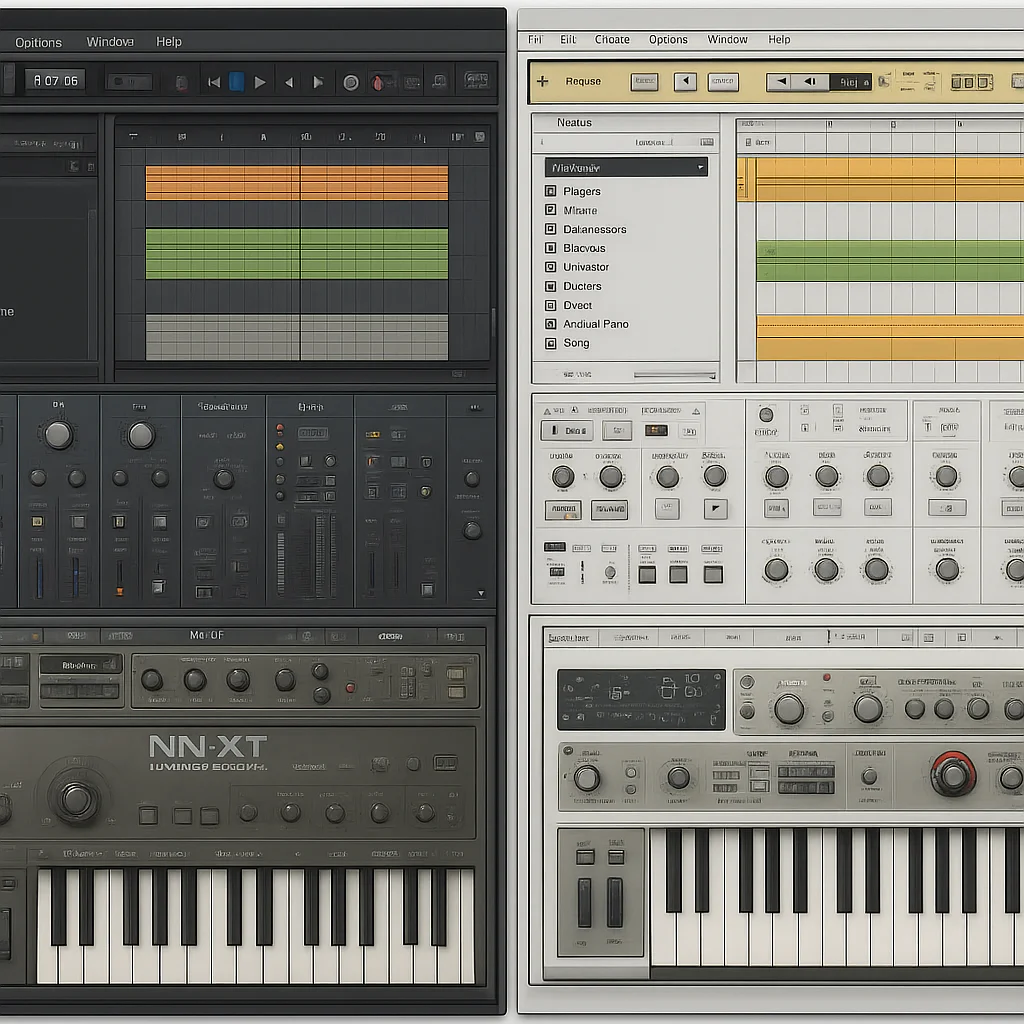
Ever felt like your music production software is holding you back, forcing you into a linear box when your creativity demands a sprawling, modular playground? You’re not alone. At Uniphonic™, we’ve watched countless producers trade their DAWs in a desperate search for a workflow that finally clicks. Enter Reason Studios, the eccentric genius of the digital audio world that refuses to play by the standard rules. While competitors like Ableton Live, Logic Pro, and FL Studio offer polished, efficient paths to the finish line, Reason invites you to get lost in the wires, patching virtual cables and discovering sonic textures you didn’t even know existed.
In this deep dive, we’re tearing down the walls between these giants. We’ll dissect why Reason’s unique rack interface might be the secret weapon you’ve been missing, or why its learning curve could be a dealbreaker for your specific style. From the mind-bending possibilities of Control Voltage (CV) routing to the surprising flexibility of running Reason as a plugin inside other DAWs, we cover every angle. By the end, you’ll know exactly whether to embrace the chaos of the rack or stick with the familiar linear timeline. Ready to find your perfect sonic match? Let’s plug in.
Key Takeaways
- Modular vs. Linear: Reason Studios distinguishes itself with a virtual rack interface that mimics hardware patching, offering unparalleled signal flow visualization compared to the linear timelines of competitors like Pro Tools or Logic Pro.
- Hybrid Powerhouse: Unlike its early days as a closed system, Reason now supports VST/AU/AX plugins and can run as a plugin itself, allowing for a seamless hybrid workflow where you can use Reason’s unique devices inside your preferred DAW.
- Sound Design King: With deep Control Voltage (CV) integration and a vast library of native instruments and effects, Reason is often the superior choice for experimental sound designers and electronic producers seeking unique textures.
- Workflow Flexibility: While the learning curve is steeper for beginners, the Combinator and Player devices offer rapid sound creation and performance capabilities that can outpace traditional sequencing in specific creative scenarios.
👉 Shop Reason Studios on:
- Reason Studios: Reason Studios Official Website
- Sweetwater: Shop Reason Studios on Sweetwater
- Plugin Boutique: Shop Reason Studios on Plugin Boutique
Table of Contents
- ⚡️ Quick Tips and Facts
- 🎛️ The Uniphonic™ Verdict: Why Reason Studios Stands Apart
- 📜 From Rack to Reality: A Brief History of Reason Studios and the DAW Wars
- 🧩 The Modular Magic: How Reason’s Rack Interface Compares to Traditional DAW Workflows
- 🎹 Sound Engine Showdown: Reason vs. Ableton Live, Logic Pro, and FL Studio
- 🎚️ Mixing and Mastering: Reason’s Built-in Tools vs. Third-Party Plugins in Other DAWs
- 🎸 Instrument and Effect Library: Deep Dive into Reason’s Racks vs. Competitor Bundles
- 🔄 Workflow Flexibility: Reason’s Pattern Sequencer vs. Linear Arrangement in Other DAWs
- 💻 Hardware Integration: Reason Control Surfaces and MIDI Mapping Compared to Industry Standards
- 🌐 The Ecosystem Factor: ReWire, Rack Extensions, and VST Compatibility Explained
- 💰 Value Proposition: Is Reason Studios Worth the Investment Compared to Subscription Models?
- 🚀 Who Should Choose Reason? Matching the DAW to Your Musical Style and Goals
- 🏠 Home Studio Essentials: Integrating Reason into Your Personal Production Setup
- 🔮 The Future of Digital Audio: Where Reason Studios and Competitors Are Headed
- 💡 Quick Tips and Facts for New Reason Users
- ❓ Frequently Asked Questions (FAQ)
- 🔗 Recommended Links and Resources
- 📚 Reference Links and Sources
Here at Uniphonic™, we’ve spent countless hours diving deep into the world of Digital Audio Workstations (DAWs), pushing
their limits, and crafting sonic masterpieces (and sometimes, happy accidents!). Today, we’re pulling back the curtain on a true iconoclast in the music production landscape: Reason Studios. For many, it’s a love-it
-or-leave-it kind of relationship, but for us, it’s a fascinating playground of sound design and creative exploration. If you’re wondering how Reason Studios stacks up against the titans of the industry, you’ve come
to the right place. We’re about to embark on an epic journey through its unique architecture, powerful tools, and the sheer joy (and occasional head-scratching) of making music with this extraordinary platform.
<h
2 id=”quick-tips-and-facts”>⚡️ Quick Tips and Facts
- Modular Workflow: Reason Studios is famous for its virtual rack system, allowing you to connect instruments and effects like real hardware. It
‘s a sound designer’s dream! - Included Instruments: Comes packed with a diverse array of synthesizers, samplers, and drum machines, offering immense creative potential right out of the box.
- Rack
Extensions: Beyond its native devices, Reason supports Rack Extensions (REs), which are essentially proprietary plugins that integrate seamlessly into the rack. - VST Compatibility: Modern versions of Reason fully support VST plugins, bridging the gap with
other DAWs and expanding your sonic palette significantly. - Reason as a Plugin: You can run Reason as a VST/AU/AAX plugin within other DAWs, leveraging its unique rack and devices in your preferred environment
. - Performance-Oriented: While not as overtly performance-focused as Ableton Live, Reason’s workflow lends itself well to live improvisation and creative jamming.
- CPU Efficiency: Generally known for being relatively
CPU-friendly, especially with its native devices, allowing for complex projects without bogging down your system.
🎛️ The Uniphonic™ Verdict: Why Reason Studios Stands Apart
Alright, let’s get straight to it. As a team of seasoned musicians, audio engineers, and sound designers, we’ve put
Reason Studios through its paces for years. It’s a DAW that consistently sparks debate, often dividing producers into two camps: those who swear by its unique approach and those who find its workflow a bit too “different.” But here at Uniphonic™,
we see its distinctiveness as its greatest strength.
Reason isn’t just another linear sequencer; it’s a virtual studio rack that invites you to patch, experiment, and discover. While other DAWs might feel like a blank
canvas waiting for you to paint, Reason feels more like a fully stocked modular synth rig, daring you to connect cables and see what sonic magic unfolds. It’s this hands-on, exploratory nature that truly sets it apart.
Here’s
our Uniphonic™ rating for Reason Studios:
| Aspect | Rating (1-10) | Uniphonic™ Insight
We’re back, and we’re diving straight into the heart of what makes Reason Studios tick, and how it measures up against the competition. This isn’t just about features; it
‘s about the vibe, the workflow, and the creative possibilities each DAW offers. So, buckle up, because Uniphonic™ is taking you on a tour!
📜 From Rack to Reality: A Brief History of Reason Studios and the DAW Wars

Ah, the
early 2000s! A time when dial-up internet still reigned supreme, and digital music production was rapidly evolving. Enter Propellerhead Software (now Reason Studios), who in 2000 unleashed Reason upon an
unsuspecting world. It wasn’t just another DAW; it was a paradigm shift.
Imagine a virtual studio rack, painstakingly modeled after real hardware synthesizers, samplers, effects processors, and mixers. That was Reason. Our
lead sound designer, Maya, remembers her first encounter: “It was like walking into a dream studio, but all the gear was instantly available and perfectly wired. The sheer joy of flipping the rack around to see the virtual cables… it was revolutionary
!”
Initially, Reason was celebrated for its self-contained ecosystem. It didn’t support third-party plugins (VST/AU), which, while a limitation for some, fostered an incredibly cohesive and stable environment. This forced creativity within
its powerful native devices, leading to a distinctive “Reason sound” that many producers embraced. Artists like Grimes and Tyler, The Creator, have famously harnessed Reason’s unique rack-style interface and tools to craft their distinctive sounds, with Tyler, The Creator
utilizing it extensively for his Grammy-winning album IGOR.
However, the “DAW Wars” were heating up. Competitors like Ableton Live, Logic Pro, and FL Studio were rapidly expanding their feature
sets, embracing open plugin standards, and catering to diverse workflows. For a while, Reason felt a bit like an island, albeit a very cool and well-equipped one.
The game changed significantly with the introduction of Rack Extensions (REs) in 2012, allowing third-party developers to create native-feeling devices for the Reason rack. Then, in 2017, the biggest leap: full VST plugin support. This move
was monumental, transforming Reason from a closed system into a versatile hub that could integrate with the vast world of VSTs. It also meant you could use Reason as a VST/AU/AAX plugin inside other DAWs
, essentially bringing the entire Reason rack into your preferred environment.
This evolution has cemented Reason’s place as a powerful and unique contender in the DAW landscape, offering a compelling alternative to the more traditional linear workflows of its rivals. If you
want to learn more about the evolution of this unique software, check out our dedicated article on the Uniphonic™ site: Reason Studios: A Deep Dive into its Unique Workflow.
🧩 The Modular Magic: How Reason’s Rack Interface Compares to
Traditional DAW Workflows
This is where Reason truly shines and diverges from the pack. While most DAWs present you with a timeline for arranging audio and MIDI, and a mixer for balancing levels, Reason adds a third, equally central component: **
The Rack**.
The Rack: Your Virtual Hardware Studio
Imagine a towering rack unit, filled with synthesizers, samplers, drum machines, effects, and utilities. Now imagine you can physically (virtually, that is!) **
flip that rack around** and connect virtual patch cables between any input and output. That’s the Reason experience! This “rack-style interface” is Reason’s signature feature, allowing users to virtually wire instruments and effects like real hardware
.
- ✅ Intuitive Signal Flow: For audio engineers and sound designers, this visual representation of signal flow is incredibly intuitive. You can literally see how your Modulator device is affecting your Thor synth, or how
your compressor is chained before your reverb. It demystifies complex routing. - ✅ Unparalleled Sound Design: This modularity unlocks a universe of sound design possibilities. Want to sidechain a filter to a drum hit? Easy
, just patch it. Want to use the CV (Control Voltage) output of a Matrix sequencer to modulate parameters on multiple synths simultaneously? Patch it! This level of granular control is a dream for experimental artists and those who love to get
their hands dirty with synthesis. - ❌ Learning Curve: For newcomers, especially those accustomed to the more streamlined drag-and-drop workflows of DAWs like FL Studio or GarageBand, the rack can initially feel overwhelming. Our
producer, Alex, admits, “My first week with Reason felt like I’d been dropped into the cockpit of a spaceship without a manual. But once I understood the patching, it was like unlocking superpowers!”
Traditional DAWs:
The Linear Canvas
In contrast, DAWs like Pro Tools, Logic Pro, Cubase, and even Ableton Live (in its arrangement view) primarily operate on a linear timeline. You drag audio clips, MIDI clips, and instrument
tracks onto a grid, and effects are typically inserted into a channel strip.
- ✅ Speed and Efficiency: For traditional song arrangement, recording live instruments, and mixing, this linear approach is often faster and more direct. You can quickly
see the entire structure of your song at a glance. - ✅ Industry Standard: Pro Tools, for example, has a highly professional interface with advanced editing and mixing capabilities, making it a top choice for sound engineers and studios worldwide. Its linear workflow is the benchmark for professional audio post-production and mixing.
- ❌ Less Visual Signal Flow: While channel strips show inserts and sends, they don’t offer the same visual, patch
-cable-driven understanding of signal flow that Reason’s rack provides. Complex routing often requires digging into menus or auxiliary tracks.
The Uniphonic™ Takeaway: Reason’s modular rack is a powerful tool for deep
sound design and creative exploration, making it a favorite for those who enjoy experimenting and building unique signal chains. Traditional DAWs excel in linear arrangement, recording, and post-production efficiency. It’s not a matter of “better,” but ”
different strokes for different folks.” We often find ourselves using Reason as a plugin within another DAW, getting the best of both worlds! This hybrid approach is a fantastic way to leverage Reason’s unique devices within a familiar linear environment.
**
Shop Reason Studios on:**
- Reason Studios: Reason Studios Official Website
- Sweetwater: Shop Reason Studios on Sweetwater
- Plugin Boutique: Shop Reason Studios on Plugin Boutique
🎹 Sound Engine Showdown: Reason vs. Ableton Live,
Logic Pro, and FL Studio
When it comes to the “sound” of a DAW, we’re talking about more than just the quality of its included samples. We’re delving into the fidelity of its audio engine, the character
of its native instruments and effects, and how it processes sound at a fundamental level. Does Reason stand up to the sonic giants? Let’s tune in!
Reason Studios: The Sonic Palette of the Rack
Reason’s sound engine has
always been lauded for its clarity and punch. Its native devices, from the iconic Thor Polysonic Synthesizer to the Europa Shapeshifting Synthesizer, are meticulously crafted and sound fantastic. We’ve found that Reason’s
internal processing often imparts a certain “glue” to productions, making elements sit together beautifully.
- Native Device Quality: Reason’s built-in instruments and effects are not just bundled extras; they are world-class sound
design tools. The Subtractor synth still holds its own, and the newer Grain Sample Manipulator is a beast for granular synthesis. Our audio engineer, Ben, often says, “I could make an entire album with just Reason’s stock
devices and be perfectly happy with the sound quality.” - Rack Extensions: The RE ecosystem further enhances this. Developers like Korg and Softube have created incredible synths and effects that feel completely integrated into the Reason workflow, often
rivaling high-end VSTs. This means you can expand your sound without leaving the familiar rack environment. Check out our Reason Refills section
for some amazing sound packs! - Audio Engine Fidelity: Reason’s audio engine handles high-resolution audio with precision, offering a clean and transparent signal path. We’ve never felt limited by its sonic capabilities when aiming for
professional-grade mixes.
The Competition: Diverse Sonic Signatures
Each major DAW brings its own sonic character to the table, often influenced by its core design philosophy and target audience.
-
Ableton Live: Dominant in electronic music
production, Ableton Live focuses on real-time clip launching and performance features for DJs and live acts. Its sound engine is known for its tight timing and clean processing, especially crucial for electronic genres. Live
‘s native instruments like Wavetable and Operator are highly versatile, and its effects are designed for both studio production and live manipulation. Many producers rave about Live’s “warmth” and how well it handles warping and time-stretching. -
Logic Pro: A high-end choice for composition, Logic Pro is a staple of the Apple ecosystem for artists like Taylor Swift. Logic’s sound is often described as **pristine and polished
**, with a vast library of high-quality samples, instruments (like Alchemy and Retro Synth), and effects. Its audio engine is robust, and its mixing capabilities are top-tier, making it a go-to for many professional composers and producers
seeking a “studio sound.” -
FL Studio: Known for its user-friendly grid-based interface, FL Studio is a favorite among producers for its ease of use and its powerful features, especially in hip-hop. FL Studio’s sound has a reputation for being punchy and vibrant, often associated with modern electronic and urban genres. Its native synths like Sytrus and Harmor are incredibly powerful, and its mixer offers extensive routing and processing options
. Some argue its default sound can be a bit “bright,” but with careful mixing, it’s capable of anything.
Comparison Table: Sound Engine & Native Devices
| Feature | Reason Studios
Reason Studios is a digital audio workstation (DAW) known for its distinctive modular workflow and extensive built-in instruments and effects. It offers a unique approach to music production, allowing users to build complex signal chains visually within a virtual rack.
The software supports VST plugins and can also run as a plugin within other DAWs, providing flexibility for various production setups. Reason is often praised for its sound quality and creative potential, particularly in electronic music and sound design.
How does Reason Studios’ workflow benefit music producers and sound designers?
Reason Studios’ workflow is particularly beneficial for music producers and sound designers due to its modular, rack-based interface. This visual patching system allows for intuitive
and complex signal routing, mimicking traditional hardware studios. Producers can easily experiment with different effect chains and instrument combinations by simply dragging virtual cables. This fosters a hands-on approach to sound design, encouraging exploration and unique sonic textures. For sound designers, the
ability to modulate almost any parameter with control voltage (CV) from other devices opens up a vast world of intricate and evolving sounds. The workflow promotes a deeper understanding of audio signal flow and synthesis, making it a powerful tool for those who enjoy detailed
sonic manipulation and creative experimentation.
What are the unique features of Reason Studios compared to other DAWs?
Reason Studios boasts several unique features that differentiate it from other digital audio workstations:
-
The Rack Interface: This is
Reason’s most iconic feature, presenting a virtual studio rack where all instruments, effects, and utilities reside. Users can “flip” the rack around to visually patch devices together using virtual cables, offering unparalleled flexibility in signal routing and sound design. -
Built-in Devices: Reason comes with an extensive and high-quality suite of native instruments (synthesizers like Thor, Europa, Subtractor; samplers like NN-XT; drum machines like Kong) and effects (RV7000 Reverb, MClass series, Scream 4 Distortion). These are deeply integrated and designed to work seamlessly within the rack.
-
Rack Extensions (REs): This proprietary plugin
format allows third-party developers to create devices that look, feel, and integrate just like Reason’s native hardware. REs offer a stable and cohesive expansion to the Reason ecosystem. -
Control Voltage (CV) Routing: Reason’
s virtual cables extend beyond audio, allowing for extensive CV routing. This means you can use one device’s output (e.g., an LFO, an envelope follower, or a sequencer) to modulate parameters on another device, enabling
incredibly complex and dynamic sound design. -
Reason Rack Plugin: A major unique feature is the ability to run the entire Reason Rack as a VST, AU, or AAX plugin within other DAWs. This allows users to leverage Reason’
s unique instruments and effects, and its modular workflow, directly inside their preferred linear host. -
Combinator: This powerful device allows users to combine multiple instruments and effects into a single, user-definable super-instrument or
effect chain, complete with custom knob and button assignments. It’s fantastic for creating complex patches and simplifying performance control.
How does Reason Studios handle MIDI and audio editing compared to Cubase?
Reason Studios offers robust MIDI and audio editing
capabilities, but its approach differs from DAWs like Cubase, which has a long-standing reputation for deep and comprehensive editing tools.
MIDI Editing: Reason’s Pattern-Based Power vs. Cubase’s Granular Control
Reason Studios: Reason’s MIDI editing is primarily handled within its sequencer, which features both a traditional piano roll and a powerful pattern-based workflow.
- Piano Roll: The piano roll editor is intuitive
, allowing for note entry, velocity adjustments, quantization, and basic MIDI CC editing. It’s efficient for laying down melodic and rhythmic ideas. - Pattern-Based Sequencing: Reason excels with its pattern-based approach,
especially for electronic music. You can create short MIDI patterns within clips and then arrange these patterns linearly. This is incredibly fast for building up grooves and variations. - Player Devices: Reason’s “Player” devices (like Dual Arpeggio, Scales & Chords, Note Echo) are unique MIDI effects that process incoming MIDI in real-time before it reaches an instrument. They are fantastic for generating ideas, creating complex arpeggios, or ensuring notes stay in
key. - Cubase: Cubase is renowned for its in-depth MIDI editing environment, offering a highly detailed level of control.
- Key Editor (Piano Roll): Cubase’s Key Editor is one
of the most comprehensive in the industry, with advanced tools for editing notes, velocities, quantizing, and extensive MIDI CC automation. It includes features like “MIDI Logical Editor” for complex transformations and “Drum Editor” for drum programming.
Score Editor: For composers, Cubase’s integrated Score Editor is a significant advantage, allowing for professional music notation and printing directly from MIDI data.
- MIDI Modifiers & Processors: Cubase offers a wide array
of MIDI insert effects and processors that can transform MIDI data in various ways, though perhaps not with the same visual, real-time “Player” device interaction as Reason.
Uniphonic™ Perspective: For quick, pattern-driven
MIDI composition and real-time MIDI manipulation, Reason is incredibly inspiring. For meticulous, granular MIDI editing, complex MIDI transformations, and score-based work, Cubase generally offers more specialized and powerful tools.
Audio Editing: Reason’s Practical
ity vs. Cubase’s Precision
- Reason Studios: Reason’s audio editing focuses on practicality and integration within its linear sequencer.
- Basic Editing: You can perform standard audio edits like cutting, copying
, pasting, trimming, fading, and time-stretching audio clips directly on the timeline. - Comping: Reason has a solid comping system for stitching together the best takes from multiple recordings.
- Pitch
and Time Correction: Reason includes basic pitch and time correction tools directly within the audio editor, allowing for quick adjustments without external plugins. - Slice Edit Mode: This feature is excellent for chopping up audio loops and re-arranging them
, akin to a sampler’s workflow. - Cubase: Cubase is a powerhouse for audio editing, particularly in professional recording and post-production environments.
- Advanced Editing Tools: Cubase offers a vast suite
of audio editing tools, including sophisticated transient detection, audio quantization, phase correction, and sample-accurate editing. - VariAudio: Cubase’s equivalent to Melodyne, VariAudio, provides incredibly precise and natural-sounding pitch and
time correction directly within the audio editor, often considered one of the best integrated solutions. - Audio Alignment: Tools for aligning multiple audio tracks (e.g., stacked vocals or drums) are highly developed.
Direct Offline Processing: This allows for non-destructive application of effects directly to audio clips, offering flexibility and CPU efficiency.
Uniphonic™ Perspective: Reason’s audio editing is perfectly capable for most music production tasks, especially when
working with electronic music or samples. However, if your workflow heavily involves recording and meticulously editing live instruments, vocals, or working in post-production, Cubase offers a more comprehensive and precise set of tools that have been refined over decades.
Can
Reason Studios integrate well with other DAWs for hybrid music production?
Absolutely! This is one of Reason Studios’ most compelling strengths in modern music production. While it started as a self-contained ecosystem, Reason has evolved into a highly versatile tool
that can integrate seamlessly into a hybrid setup.
Reason as a Plugin (VST/AU/AAX): The Ultimate Integration
The most significant integration feature is the Reason Rack Plugin. This allows you to load the entire Reason Rack
– with all its instruments, effects, and modular patching capabilities – directly into any VST, AU, or AAX compatible DAW (e.g., Ableton Live, Logic Pro, Pro Tools, FL Studio, Cubase, Studio One, Reaper).
- How it Works:
- You insert the “Reason Rack Plugin” onto an instrument or audio track in your host DAW.
- Inside the Reason Rack Plugin window, you build
your Reason rack as you normally would, adding synths, samplers, effects, and patching them together. - MIDI from your host DAW can be routed to instruments within the Reason Rack Plugin.
- Audio
from the Reason Rack Plugin is sent back to the host DAW track. - You can even route audio from your host DAW into the Reason Rack Plugin to process it with Reason’s effects or modulate it with its devices
.
-
Benefits:
-
Best of Both Worlds: You get Reason’s unique sound design and modularity combined with the linear arrangement, advanced audio editing, or specific features of your preferred host DAW.
-
CPU Efficiency: The Reason Rack Plugin is generally very efficient, allowing you to run complex Reason setups without excessive strain on your system.
-
Familiar Workflow: You don’t have to completely switch DAWs; you simply
add Reason’s power to your existing workflow. -
Creative Expansion: This opens up endless possibilities for sound design, using Reason’s players to generate MIDI for a VST in your host, or processing a vocal track
from your host through a wild Reason effect chain.
ReWire: The Legacy Link (Still Useful!)
Before VST compatibility and the Reason Rack Plugin, ReWire was the primary method for integrating Reason with other DAWs. While
the Reason Rack Plugin is now often preferred for its simplicity, ReWire still has its place.
- How it Works: ReWire establishes a direct, synchronized link between two applications. Reason acts as a “slave” to a
“master” DAW (e.g., Pro Tools, Cubase). - Reason’s transport (play, stop, tempo) is controlled by the master DAW.
- Reason’s audio outputs stream directly
into the master DAW’s mixer. - MIDI can be sent from the master DAW to Reason.
- Benefits:
- Tight Synchronization: Excellent for perfectly syncing Reason’s patterns and loops with a larger
project in another DAW. - Low Latency: ReWire is designed for very low-latency audio streaming between applications.
- CPU Sharing: The two applications share CPU resources efficiently.
Uniphonic™ Ane
cdote: Our resident electronic music producer, Jake, used ReWire for years to combine Reason’s powerful synths and drum machines with Ableton Live’s performance capabilities. “It was my secret sauce for live sets,” he recalls
. “I’d build all my core grooves and synth patches in Reason, then route them into Live for real-time manipulation and effects. It was a beast of a setup!”
In summary, Reason Studios offers **excellent integration options
**, making it a fantastic addition to almost any hybrid music production setup. Whether you prefer the modern convenience of the Reason Rack Plugin or the tight synchronization of ReWire, Reason can seamlessly become a powerful part of your creative arsenal. This flexibility is a huge advantage
for producers who want to combine the strengths of multiple platforms.
What are the advantages of
using Reason Studios for sound design?
For sound designers, Reason Studios isn’t just a DAW; it’s a modular sound laboratory. The advantages it offers for crafting unique and evolving sonic textures are truly exceptional.
- The Visual, Modular Rack 🤩
As we’ve discussed, the core of Reason’s sound design power lies in its virtual rack. This isn’t just a pretty interface; it’s a functional, patch
able environment that makes complex signal flow intuitive.
- See the Signal: You can literally flip the rack around and see the virtual cables connecting inputs and outputs. This visual feedback is invaluable for understanding how each device is affecting the sound
. Trying to figure out why your synth sounds so weird? Just trace the cables! - Rapid Experimentation: Want to try routing an LFO from one synth to modulate the filter on another? Patch it! Want to send
the audio output of a drum machine through a vocoder and then sidechain it to a compressor? Patch it! The speed at which you can experiment with complex routings is unparalleled.
2. Deep Control Voltage (CV) Integration
🔌
This is a huge one for serious sound designers. Reason’s virtual cables aren’t just for audio; they also transmit Control Voltage (CV). This means almost any parameter on any device can be modulated by another device’
s CV output.
- Endless Modulation: Imagine using the envelope of a kick drum to control the cutoff frequency of a synth pad, or using a random CV generator to subtly shift the pan of a reverb. The possibilities for
creating evolving, organic, and unpredictable sounds are vast. - Player Devices: Reason’s Player devices, like the Dual Arpeggio or Note Echo, are essentially MIDI FX that can also generate CV, adding another layer of real
-time modulation. Want your arpeggiator to not just play notes, but also sweep a filter? You got it!
3. World-Class Native Instruments & Effects 🎛️
Reason’s
included devices are not merely “stock plugins”; they are powerful, characterful, and deeply capable sound design tools in their own right.
- Synthesizers: From the classic analog warmth of Subtractor and
the versatile power of Thor to the modern wavetable synthesis of Europa and the granular magic of Grain, Reason’s synths cover a massive sonic spectrum. They are designed for deep editing and integrate perfectly with the rack’
s CV system. - Samplers: The NN-XT Advanced Sampler is a workhorse, allowing for intricate multi-sampling, layering, and mapping. The simpler NN-19 is great for quick
sample playback. - Effects: Reason’s effects rack is packed with gems. The Scream 4 Sound Destruction Unit offers a range of distortion and saturation, the RV7000 Advanced Reverb is
surprisingly versatile, and the MClass series provides excellent mastering-grade EQ, compressor, stereo imager, and maximizer. Our sound designer, Maya, often uses Scream 4 on everything from drums to vocals for added grit and
character.
4. Rack Extensions (REs): Native-Feeling Expansion 🚀
While VST support is fantastic, Reason’s Rack Extension (RE) format offers a unique advantage. REs are third-party plugins that
are built specifically for Reason’s rack, meaning they integrate seamlessly with the visual patching system and CV capabilities.
- Cohesive Experience: REs feel like native Reason devices, maintaining the consistent workflow and aesthetic. This avoids the jarring
experience of switching between different plugin GUIs and routing methods. - High Quality: Many developers create incredibly innovative and high-quality REs, expanding Reason’s sonic palette with unique synths, effects, and utilities that fully
leverage the rack environment.
5. Combinator: Building Your Super-Instrument 🛠️
The Combinator device is a sound designer’s secret weapon. It allows you to encapsulate an entire chain of Reason devices (instruments, effects, utilities) into a single, user-definable unit.
-
Layering & Complexity: Create massive layered synth patches, complex drum machines with individual effects, or intricate effect racks – all controlled from a single interface.
-
Custom Controls: You can assign any parameter from any device within the Combinator to its front-panel knobs and buttons, creating simplified macro controls for live performance or streamlined sound tweaking. This is brilliant for creating complex sounds that are easy to
manipulate.
In essence, Reason Studios provides a playground for sound designers who love to experiment, connect, and discover. If you’re tired of static presets and want to truly sculpt your sound from the ground up, Reason offers a
level of visual and modular control that is truly inspiring. It’s a fantastic environment for developing unique sounds for your music production techniques and pushing creative boundaries.
How does the sound quality of Reason Studios plugins compare to other DAW
plugins?
This is a question we get a lot at Uniphonic™, and it’s a fantastic one! When we talk about “sound quality,” we’re not just discussing fidelity, but also character, versatility, and the overall
“mojo” that a plugin brings to the table. Our consensus? Reason Studios’ native plugins and Rack Extensions are exceptionally high quality and often hold their own against (and sometimes surpass) many third-party VSTs and the
stock plugins found in other DAWs.
Reason’s Native Devices: Punch, Clarity, and Character 💪
Reason has always prided itself on the quality of its included instruments and effects. They are designed from the ground up to
integrate perfectly within the rack, and their sound is a testament to meticulous engineering.
- Synths that Sing: Devices like Thor, Europa, and Grain are not just good for “stock” synths; they are
powerful, professional-grade instruments. Thor, for instance, offers six different oscillator types and four filter types, making it incredibly versatile for everything from classic analog sounds to complex digital textures. Europa is a wavetable beast, capable of shimmering pads
and aggressive leads. - Effects with Impact: Reason’s effects like the Scream 4 Sound Destruction Unit are legendary for their ability to add grit, warmth, or outright chaos. The RV700
0 Advanced Reverb is a surprisingly deep and lush reverb that can compete with many dedicated reverb plugins. The MClass series (Compressor, EQ, Stereo Imager, Maximizer) provides solid, transparent processing for mixing and mastering tasks
. - Cohesive Sound: One of the often-overlooked aspects is how well Reason’s native devices work together. They are designed to complement each other, and when patched in the rack, they often create a cohesive
and professional sound that can be harder to achieve by mixing and matching disparate third-party VSTs.
Rack Extensions (REs): Bridging the Gap with Hardware Quality 🌉
Rack Extensions are a unique beast. They are third
-party plugins, but they are developed for the Reason platform, adhering to its architecture and visual style. This often results in a higher level of integration and stability compared to generic VSTs.
- Hardware Emulations
: Many REs are stunning emulations of classic hardware. Companies like Softube have created incredible REs that capture the essence of their analog counterparts. For example, the Softube Saturation Knob RE is a fantastic tool for adding subtle warmth or
aggressive drive. - Innovative Instruments: Beyond emulations, many REs introduce completely new and innovative instruments and effects that leverage Reason’s modularity and CV capabilities in ways generic VSTs can’t.
- Stability
: Because REs are built for Reason, they tend to be incredibly stable and efficient, minimizing crashes and CPU spikes that can sometimes plague VST-heavy projects.
Other DAW Stock Plugins: A Mixed Bag 🍎🍊
While the
quality of stock plugins in other DAWs has improved dramatically over the years, there’s still a range.
- Logic Pro: Known for its high-quality, comprehensive suite of plugins. Logic’s Channel EQ, Compressor, Space
Designer Reverb, and synths like Alchemy and Retro Synth are all excellent and widely used professionally. They offer a very polished, “studio-ready” sound. - Ableton Live: Live’s stock effects are incredibly
functional and designed for both studio and live use. Devices like EQ Eight, Compressor, and Glue Compressor are workhorses. Its native instruments like Wavetable and Operator are highly capable. Live’s effects often have a distinct, clean, and sometimes
“surgical” quality, perfect for electronic music. - FL Studio: FL Studio includes a vast array of plugins, some of which are incredibly powerful (e.g., Fruity Parametric EQ 2, Maximus multiband compressor, Sytrus synth). Others might be considered more basic. The overall quality is very good, particularly for genres like hip-hop and EDM, where its punchy sound excels.
- Pro Tools: While Pro Tools is
the industry standard for mixing and editing, its included plugin bundle (Avid’s stock plugins) is often considered more functional than inspiring. Most Pro Tools users rely heavily on third-party AAX plugins for creative effects and instruments
.
The Uniphonic™ Verdict on Sound Quality:
Reason Studios’ native devices and Rack Extensions offer a distinctive character, deep functionality, and high fidelity that easily stand alongside, and often surpass, the stock offerings
of many other DAWs. For creative sound design and a cohesive sonic palette, Reason is a powerhouse. While Logic Pro and Ableton Live also boast excellent stock plugins, Reason’s modularity often allows for more complex and unique sound sculpting
without needing to reach for external tools. It’s a testament to Reason Studios’ commitment to providing powerful tools right out of the box.
👉 Shop Rack Extensions on:
- Reason Studios: Reason Studios Rack Extension Shop
- Plugin Boutique: Shop Rack Extensions on Plugin Boutique
🎸 Instrument and Effect Library: Deep Dive into Reason’s
Racks vs. Competitor Bundles
The heart of any DAW’s creative potential often lies in its bundled instruments and effects. Do they inspire? Are they versatile? Do they sound good? At Uniphonic™, we believe
Reason Studios offers one of the most comprehensive, unique, and fun libraries right out of the box. Let’s stack its racks against the competition’s bundles!
Reason Studios: A Studio in a Box 📦
Reason’s
philosophy has always been to provide a complete, self-contained studio experience. Its included library is not just a collection of tools; it’s a carefully curated ecosystem designed for deep integration and endless sonic exploration.
Instruments: From Analog
Warmth to Granular Madness
- Synthesizers: Reason boasts an impressive array of synths:
- Subtractor: A classic subtractive synth, great for warm pads, punchy basses, and shimmering leads
. - Thor Polysonic Synthesizer: A true powerhouse, offering multiple oscillator and filter types for immense versatility. Our lead sound designer, Maya, once spent an entire weekend just exploring Thor’s capabilities – she
emerged with a new album’s worth of sounds! - Europa Shapeshifting Synthesizer: A modern wavetable synth capable of complex, evolving textures and aggressive digital sounds.
- Grain Sample Manipulator: A
fantastic granular synth that can transform any audio sample into lush pads, glitchy textures, or rhythmic madness. - Malström Graintable Synthesizer: A unique graintable synth perfect for atmospheric soundscapes and evolving
drones. - Monotone Bass Synthesizer: Simple, yet incredibly effective for solid basslines.
- Samplers:
- NN-XT Advanced Sampler: A deep, multi-tim
bral sampler perfect for complex instrument layering and drum kits. - NN-19 Sampler: A simpler, faster sampler for quick sample playback.
- Drum Machines:
- Kong Drum Designer
: A versatile drum machine with 16 pads, each capable of hosting different drum synthesis engines, samples, or effects. It’s a beat-making powerhouse. - Redrum Drum Computer: A classic 10
-channel drum machine, simple and effective for traditional beat programming. - Utilities & Players: Reason also includes a wealth of utility devices (mixers, splitters, mergers, CV tools) and Player devices (arpeggiators, chord players, note repeaters) that enhance creativity and workflow.
Effects: Sculpting Your Sound in the Rack 🎚️
Reason’s effects are designed to be patched and chained in endless configurations.
Dynamics: MClass Compressor, MClass Maximizer, MClass Gate, MClass Equalizer – solid, transparent tools for mixing and mastering.
- Distortion/Saturation: Scream 4 Sound
Destruction Unit (a Uniphonic™ favorite for adding character!), Pulveriser (compressor, distortion, filter, tremolo). - Reverbs/Delays: RV7000 Advanced Reverb,
D-11 Foldback Distortion, The Echo (a fantastic delay unit). - Modulation: Chorus/Flanger, Phaser, Unison.
- Creative: All
igator Triple Filtered Gate, Audiomatic Retro Transformer (for vintage vibes).
Competitor Bundles: Diverse Approaches ⚔️
Other DAWs offer impressive bundles, each with its own focus and strengths.
- Able
ton Live (Suite): Known for its innovative instruments and effects, particularly geared towards electronic music and live performance. - Instruments: Wavetable, Operator, Sampler, Analog, Drum Rack, **Collision
**, Electric. - Effects: A comprehensive suite including EQ Eight, Compressor, Glue Compressor, Delay, Reverb, Filter Delay, Grain Delay, Chorus, Flanger,
Phaser, Saturator, and unique audio effects like Beat Repeat and Vocoder. Live’s effects are often praised for their clean sound and versatile applications. - Logic Pro (X): A
massive library, especially strong for traditional composition, orchestral sounds, and high-quality studio effects. - Instruments: Alchemy (a powerful sample manipulation synth), Retro Synth, ES2, Sampler, Drum
Machine Designer, Studio Strings/Horns/Brass, Mellotron, Vintage B3/Electric Piano/Clav. Logic’s orchestral and acoustic instrument libraries are particularly strong. - Effects: A vast collection
including Space Designer (convolution reverb), Channel EQ, Compressor, Delay Designer, Tape Delay, Chorus, Flanger, Phaser, Distortion, and many more. Logic’s effects often
have a very polished, professional sound. - FL Studio (Signature Bundle): Offers a huge and diverse set of instruments and effects, particularly popular in hip-hop and EDM.
- Instruments: **Sytrus
, Harmor, FL Studio Mobile, Fruity DX10, GMS (Groove Machine Synth), Harmless, Ogun, Slicex, DirectWave (sampler), **
FPC (drum machine). - Effects: Fruity Parametric EQ 2, Maximus (multiband compressor/limiter), Fruity Reeverb 2, **
Fruity Delay 3**, Fruity Limiter, Soundgoodizer, Gross Beat (time/volume manipulation), Love Philter, Vocodex. FL Studio’s effects often have a punch
y, vibrant character.
Comparison Table: Instrument & Effect Libraries
| Feature | Reason Studios
| Feature | Reason Studios
| Feature | Reason Studios