
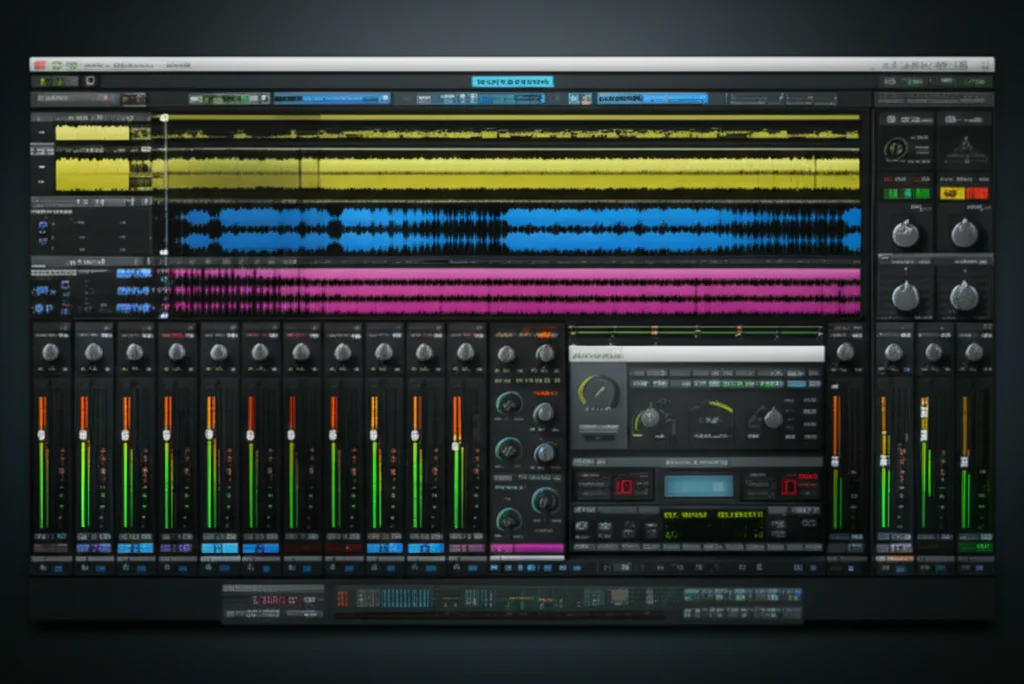
Are Reason Refills compatible with other digital audio workstations besides Reason? Not as complete libraries in most cases: DAWs such as Ableton Live, Logic Pro, and FL Studio generally can’t open .rfl files directly. You can still use many ReFill sounds outside Reason by hosting Reason Rack Plugin, importing compatible audio or REX files, or exporting sounds from Reason.
The key distinction is what’s inside the ReFill. A WAV sample can usually travel easily; a Combinator patch built from Reason devices needs the Reason environment. We’ve seen producers spend longer searching for a “ReFill import” button than it takes to load Reason Rack Plugin or bounce the sound to audio.
Key Takeaways
- ReFills usually don’t open directly in other DAWs.
- Reason Rack Plugin is the most direct way to play Reason patches inside a compatible host.
- WAV files are highly portable; REX/RX2 support varies by DAW and version.
- Export or render audio for reliable collaboration when the recipient doesn’t have the same Reason setup.
- Check plugin, ReFill, and device requirements before building a project around a patch.
Table of Contents
- ⚡️ Quick Tips and Facts
- 🧭 Reason Refills Explained: A Brief History of the Sound Library Format
- 🎛️ What’s Inside a Reason ReFill?
- Reason patches, Combinators, samples, loops, and REX files
- Why a ReFill is not just a folder of audio files
- 🔌 Are Reason Refills Compatible With Other DAWs?
- Using ReFills in Ableton Live, Logic Pro, FL Studio, Cubase, and more
- What works directly—and what needs Reason
- 🎹 Use Reason Refills Outside Reason With the Reason Rack Plugin
- Loading ReFill sounds in a DAW with Reason Rack
- Standalone Reason versus the Reason Rack Plugin
- Plugin formats, DAW support, and version considerations
- 📦 How to Access ReFill Content in Another DAW
- 1. Open ReFill instruments and patches through Reason Rack
- 2. Extract or export audio samples for direct DAW use
- 3. Convert REX loops into audio or MIDI workflows
- 4. Recreate sounds with compatible instruments and effects
- 🔄 ReFill File Types and What You Can Do With Them
- REX and RX2 loops
- WAV samples and audio exports
- Reason instrument patches and Combinators
- Device presets, effects, and song files
- 🧰 ReFill Compatibility by Content Type
- 🪜 Step-by-Step: Getting ReFill Sounds Into Your DAW
- Using Reason Rack as a plugin
- Exporting samples from Reason
- Working with REX loops in other software
- ⚠️ Common Compatibility Problems and Fixes
- A ReFill will not open or appears empty
- Missing devices, patches, or samples
- DAW plugin scanning and format issues
- Licensing, installation, and operating-system limitations
- ✅ Best Workflows for Producers Using Multiple DAWs
- Keep the Reason Rack setup for editable instruments
- Export audio when you need maximum portability
- Organize and back up your ReFill library
- 🆚 Reason ReFills vs. Standard Sample Packs
- 🎯 Who Should Use Reason ReFills Outside Reason?
- Conclusion
- Recommended Links
- FAQ
- Can I open a Reason ReFill directly in Ableton Live?
- Can I use Reason ReFills in Logic Pro or FL Studio?
- Do I need Reason to use a ReFill?
- Can I extract WAV files from a ReFill?
- Can other DAWs play REX or RX2 files?
- Will a Reason Rack plugin preset include its ReFill samples?
- Are all ReFills compatible with every version of Reason?
- Reference Links
Quick Tips and Facts
Reason ReFills are Reason-native sound libraries. They can contain instrument patches and Combinator setups that rely on Reason devices, alongside formats such as REX loops and audio samples that may work elsewhere.
| Quick fact | What it means for your workflow |
|---|---|
| A ReFill is not a universal DAW library format | Ableton Live, Logic Pro, FL Studio, Cubase, and other DAWs generally do not load .rfl files as native sound libraries. |
| Reason Rack Plugin is the most direct bridge | Load the Reason Rack Plugin inside a compatible DAW, then use supported ReFill content through Reason’s devices and browser. |
| Some contents travel better than others | REX/RX2 loops and exported WAV files are more portable than Reason instrument patches. |
| REX support varies by host and version | Reason Studios describes REX as “widely supported by music software and digital audio workstations,” but you should verify support in your specific DAW and edition. |
| Exports are the safest handoff | If another producer does not have the same ReFill or Reason setup, render the sound to audio or export the needed samples. |
| Older workflows can cause confusion | ReWire is discontinued; for current projects, use a plugin workflow, MIDI, or audio export instead. |
Fast answer: A ReFill usually won’t open directly in another DAW. You can use its Reason instruments through Reason Rack Plugin, or use compatible contents such as REX files and audio samples in a way your DAW supports. For more production workflow ideas, browse our music production techniques.
Reason ReFills Explained: A Brief History of the Sound Library Format
A Reason ReFill is a packaged collection designed for the Reason music-production environment. Think of it less like a folder of generic samples and more like a container that can bundle sounds with the Reason devices needed to play them.
That distinction matters. A ReFill might include a drum loop you can use in several programs, a synth patch built for a Reason instrument, or both. The contents—not just the file extension—determine what can move to another DAW.
Reason Studios’ ReFill documentation distinguishes among native Reason patches, Rack Extension patches, REX files, and other included material. The official guidance is the best starting point when claims about compatibility get fuzzy.
Why the ReFill format exists
ReFills made it possible to package a collection for Reason users while preserving relationships between sounds and devices. A patch can depend on a particular instrument, sample set, or effects chain. Keeping those pieces together helps a Reason project recall the intended sound.
But that convenience comes with a trade-off: a patch designed around Reason’s devices is not automatically portable to a DAW that does not include those devices. Our sound designers often describe it as a recipe written for a particular kitchen. You can carry the ingredients elsewhere, but the whole recipe may not work without the same equipment.
A note on ReWire and older advice
Some older guides recommend ReWire to synchronize Reason with another music program. That advice is now historical: Reason Studios discontinued ReWire, so it should not be your plan for a current setup. Use Reason Rack Plugin, MIDI, or rendered audio instead.
What’s Inside a Reason ReFill?
A ReFill may contain several kinds of assets. Some are closely tied to Reason; others are familiar audio or loop formats.
| Content type | Typical role | Portability outside Reason |
|---|---|---|
| Reason instrument patch | Preset for a Reason device, often with sound settings and sample references | Low unless used in Reason Rack Plugin or recreated |
| Combinator patch | A layered instrument or effects setup built from Reason devices | Low; requires the relevant Reason devices and compatible content |
| Rack Extension patch | Preset for a Reason Rack Extension | Low; requires the relevant Rack Extension and Reason environment |
| REX/RX2 loop | Sliced rhythmic audio with timing and slice information | Variable; depends on the DAW or another compatible tool |
| WAV sample | Audio recording, one-shot, or rendered loop | High; supported by most audio workstations |
| MIDI file | Note and performance information | Usually high, though instruments and articulations differ |
| Reason song or device-specific data | Project or settings for Reason | Generally Reason-specific |
Contents vary by ReFill. Do not assume every ReFill contains loose WAV files or that every file inside can be extracted and used independently. Check the product description and licensing terms before building a workflow around it.
Reason patches, Combinators, samples, loops, and REX files
A Reason patch stores settings for a compatible Reason device. A Combinator patch can group instruments and effects into one playable setup, but the setup still depends on the devices and any required ReFills or Rack Extensions.
REX files are different: they contain sliced loop material and timing information. Reason Studios says REX is “widely supported by music software and digital audio workstations.” That’s encouraging, but support is not universal and can vary by host, version, and file type. Check your DAW’s documentation before relying on direct REX import.
Audio samples such as WAV files are typically the most straightforward to move. You can import them into a sampler, audio track, or drum instrument—provided your use is permitted by the ReFill’s license.
Why a ReFill is not just a folder of audio files
Some ReFills bundle audio with presets that tell a Reason device how to play it. A multisampled instrument, for example, may use multiple samples mapped across keys and velocity ranges. Exporting one sample from that instrument does not necessarily reproduce the complete patch.
Similarly, a Combinator may depend on layered devices, modulation, and effects. A pile of isolated files cannot automatically preserve all of that behavior. The more a sound depends on Reason’s instruments and routing, the more faithfully you’ll need Reason Rack Plugin or a careful recreation.
Are Reason Refills Compatible With Other DAWs?
Not as complete ReFill libraries, in most cases. Other DAWs generally do not browse and load a Reason ReFill as though it were a native Ableton Live Pack, Logic instrument library, or FL Studio preset bank.
There are three practical paths:
- Load Reason Rack Plugin in the other DAW and use Reason devices there.
- Use portable assets such as compatible REX files, WAV samples, or MIDI files.
- Render or recreate sounds from Reason for a project that needs to travel without the Reason setup.
The first path preserves the most of the original instrument experience. The second offers the best compatibility. The third is often the least fragile when collaborating or archiving.
Using ReFills in Ableton Live, Logic Pro, FL Studio, Cubase, and more
A DAW can host Reason Rack Plugin if the plugin format and your installed versions are supported. The plugin is the bridge; the DAW does not magically learn to open .rfl files on its own.
| DAW | Practical route | Key point |
|---|---|---|
| Ableton Live | Host Reason Rack Plugin; import supported audio or loop formats | For a Reason patch, use the plugin rather than looking for a direct ReFill import command. |
| Logic Pro | Host Reason Rack Plugin where supported; use audio/MIDI assets as appropriate | Confirm plugin format and compatibility for your Logic and Reason versions. |
| FL Studio | Host Reason Rack Plugin; import audio or compatible loop files | Plugin hosting and REX handling are separate questions. |
| Cubase | Host Reason Rack Plugin; import supported audio formats | Check the current plugin and system requirements from both vendors. |
| Other plugin-compatible DAWs | Use Reason Rack Plugin if the host supports the required format | A compatible plugin host does not guarantee every ReFill device or extension is installed. |
Reason Studios’ current Reason product information and system requirements are the places to verify supported plugin formats and operating systems. DAW support can change between software versions, so avoid relying on an old forum post as a compatibility certificate.
What works directly—and what needs Reason
| ReFill asset or feature | Direct use in another DAW? | Usually needs Reason? |
|---|---|---|
| ReFill package as a complete library | ❌ Generally no | ✅ Yes |
| Reason instrument patch | ❌ Usually no | ✅ Yes, or a faithful recreation |
| Combinator patch | ❌ Usually no | ✅ Yes, plus required devices/content |
| REX/RX2 loop | ⚠️ Sometimes | Not always; depends on host or conversion tool |
| WAV sample | ✅ Usually | ❌ No |
| MIDI file | ✅ Often | ❌ No, but an instrument is needed to make sound |
| Rendered Reason audio | ✅ Yes | ❌ No |
The main source of disagreement online is that “using a ReFill” can mean two different things: opening the ReFill itself or using one of its contents. Freebie Bag’s guide describes the Reason-native format and recommends Reason Rack Plugin or exported audio for other DAWs; Reason Studios’ own documentation clarifies why REX files are a partial exception. Both can be true at once.
Use Reason Refills Outside Reason With the Reason Rack Plugin
The Reason Rack Plugin lets you use Reason instruments and effects inside a compatible DAW. In practice, you open your host project, load the plugin on an instrument track, and use Reason’s rack and browser to access available devices and content.
This is usually the best choice when you want to keep a patch editable rather than print it immediately to audio. It can also make a hybrid setup feel natural: sequence in Ableton Live, arrange in Logic Pro, or build a beat in FL Studio while playing Reason instruments from the plugin.
Loading ReFill sounds in a DAW with Reason Rack
The exact browser labels and menus can vary by Reason version, but the general workflow is:
- Install Reason and the ReFill using the supported installer or library-management method.
- Launch Reason once and confirm that the ReFill appears in Reason’s browser.
- Open your DAW and create an instrument track.
- Insert Reason Rack Plugin in the track’s instrument slot.
- Browse for the desired Reason device or patch inside the plugin.
- Play notes from the DAW’s MIDI track or an attached controller.
- Save the project and verify that the plugin can find the ReFill and any required devices.
- Render a test audio file before sending the project to another system.
That last check catches the classic studio surprise: the session opens, the track is there, and the synth patch has gone on an unannounced holiday.
Standalone Reason versus the Reason Rack Plugin
| Workflow | Best for | Trade-off |
|---|---|---|
| Standalone Reason | Projects built mainly in Reason, ReFill browsing, full Reason environment | Less integrated with another DAW’s arrangement and mixing tools |
| Reason Rack Plugin | Playing Reason devices inside a supported host | Requires compatible plugin hosting, Reason installation, and any needed content |
| Exported audio | Sharing, archiving, final mix, portability | No longer editable as an instrument patch |
| MIDI plus another instrument | Reusing note performance or rebuilding a sound | The replacement patch may not sound identical |
Use the plugin when the sound design matters and you expect to keep tweaking. Print audio when the sound is approved and you need a dependable handoff. We often keep both: the MIDI and plugin track muted for revisions, plus a rendered audio track ready for the mix.
Plugin formats, DAW support, and version considerations
Plugin compatibility depends on more than the DAW’s name. Check:
- Whether your DAW supports the plugin format provided by your installed Reason version.
- Whether the plugin is available for your operating system and processor architecture.
- Whether Reason, the DAW, and any required Rack Extensions are compatible versions.
- Whether the ReFill depends on devices that are installed and authorized on your system.
Use official documentation from Reason Studios and the relevant DAW vendor, such as Ableton’s supported plugin formats or Apple’s Logic Pro information. A plugin may scan successfully while a specific patch still reports missing content; plugin installation and ReFill availability are separate checks.
How to Access ReFill Content in Another DAW
Before choosing a method, ask one question: Do you need the sound to remain editable, or do you simply need it to play? Editable instruments point toward Reason Rack Plugin. Finished sounds point toward audio export. A loop may be portable as REX or converted audio. That simple decision saves a surprising amount of file-format archaeology.
1. Open ReFill instruments and patches through Reason Rack
Use this route for Reason patches, Combinators, and device-based sound design.
- Install the required Reason version, ReFill, and any necessary Rack Extensions.
- Open the ReFill in Reason’s browser and confirm that the patch loads.
- Open your DAW and insert Reason Rack Plugin on an instrument track.
- Load the patch or device combination inside the plugin.
- Send MIDI from your DAW and confirm the expected notes and controls.
- Save, close, and reopen the session to test that the patch recalls correctly.
Benefit: the Reason patch remains playable and adjustable.
Drawback: collaborators may need the same software, ReFill, Rack Extensions, and compatible setup.
2. Extract or export audio samples for direct DAW use
If the ReFill includes ordinary audio files, use them according to the file format and license. For a patch that only exists as a Reason instrument, render it from Reason rather than assuming the ReFill can be unpacked into a clean folder of samples.
A practical export workflow:
- Load the patch in Reason or Reason Rack Plugin.
- Record or render a sustained note, phrase, loop, or set of one-shots.
- Export at a suitable sample rate and bit depth for the project.
- Import the result into your DAW’s audio track or sampler.
- Trim tails and silence; check that loop points and transients behave as intended.
- Keep the source project and document any effects or pitch-processing choices.
For multi-note instruments, don’t export only one key and expect a full keyboard instrument. You may need to render several notes and velocity layers, then map them in a sampler such as Native Instruments Kontakt or your DAW’s built-in sampler. That can take time, but it creates a more portable instrument.
3. Convert REX loops into audio or MIDI workflows
REX files preserve slices and rhythmic timing information. Some DAWs or tools can use REX directly; others may require a supported converter or an export from Reason.
Try this sequence:
- Check your DAW’s manual for REX or RX2 import support.
- If supported, import the loop and test tempo changes, slice playback, and project recall.
- If unsupported, open the loop in a compatible application or Reason and render it as WAV.
- For flexible arrangement, use the slices or MIDI information if your chosen tool can provide them.
- Confirm the result against the original loop at the target tempo.
Avoid calling every time-stretched loop “lossless.” Slice-based playback can preserve transients well, but changing tempo, pitch, or slice behavior can still alter the sound. Reason Studios’ overview of ReFills and REX content is useful for understanding what the format is designed to do.
4. Recreate sounds with compatible instruments and effects
Sometimes the goal is not to preserve the original patch but to get close in another environment. In that case, identify the parts of the sound that matter:
- Source: sampled instrument, synth oscillator, or layered combination.
- Envelope: attack, decay, sustain, and release.
- Tone: filter cutoff, resonance, modulation, and saturation.
- Space: reverb, delay, chorus, and stereo width.
- Performance: velocity response, pitch movement, and articulation.
Rebuild those elements using your DAW’s instruments or plugins, then compare against a rendered reference. For plugin ideas, see our plugin recommendations and hardware vs. software guides. A close recreation is often more convenient than preserving an elaborate rack, but it may not be an exact match.
ReFill File Types and What You Can Do With Them
REX and RX2 loops
REX is a sliced audio-loop format. Its main advantage is that rhythmic material can be played back slice by slice, making tempo changes and rearrangement more flexible than treating the whole loop as one fixed audio file.
Reality check: support depends on the DAW or tool. If direct import fails, render the loop to WAV from a compatible application and use that audio in your host.
WAV samples and audio exports
WAV is a broadly supported audio format and is often the easiest route between DAWs. A one-shot can be dropped into a sampler; a rendered phrase can be placed on an audio track.
Watch for:
- Sample rate and bit-depth conversion.
- Mono versus stereo files.
- Loop points and tail length.
- Licensing terms for commercial use.
- Whether a file is a raw sample or a processed, ready-to-use sound.
Reason instrument patches and Combinators
Reason patches are intended for compatible Reason devices. A patch may require a specific device, a particular Reason version, a Rack Extension, or other content. Combinators can contain a layered arrangement of instruments and effects, so the sound may be more than one preset file.
Reason Studios’ ReFill developer documentation says Combinator patches should use native Reason devices or Rack Extensions and should not depend on external VST plugins or software outside the Reason platform. That design rule helps make the patch work within Reason; it does not make the patch natively loadable in another DAW.
Device presets, effects, and song files
Presets for Reason devices and effects are generally tied to their host devices. A Reason song file is not a universal session file, either. If you need to share a project with a producer using another DAW, export stems or audio and provide MIDI where helpful.
A clean handoff often includes:
- Consolidated audio stems.
- MIDI files for parts that should remain editable.
- Tempo and time-signature details.
- A note listing required ReFills, plugins, and processing.
- A dry or less-processed version of important sounds.
ReFill Compatibility by Content Type
| Asset | Works in Reason? | Works in another DAW? | Best practical solution |
|---|---|---|---|
.rfl ReFill package |
✅ | ❌ Usually not directly | Open in Reason or use Reason Rack Plugin |
| Reason synth or sampler patch | ✅ | ❌ Usually not directly | Use Reason Rack Plugin or recreate it |
| Combinator setup | ✅ | ❌ Usually not directly | Use plugin; render audio for portability |
| REX/RX2 loop | ✅ | ⚠️ Depends on host/tool | Test direct import or convert/render |
| WAV one-shot or loop | ✅ | ✅ Usually | Import into audio track or sampler |
| MIDI file | ✅ | ✅ Often | Import and assign an instrument |
| Rendered stem | ✅ | ✅ Yes | Import as audio |
Most portable: WAV and rendered audio.
Most editable in its original form: Reason patch inside Reason or Reason Rack Plugin.
Most likely to need a compatibility check: REX/RX2 and device-dependent patches.
Step-by-Step: Getting ReFill Sounds Into Your DAW
Using Reason Rack as a plugin
- Verify system compatibility. Check your Reason version, operating system, DAW version, and supported plugin format on the vendors’ official pages.
- Install and authorize Reason. Confirm that the standalone application opens correctly before troubleshooting the plugin.
- Install the ReFill. Use its official installer or the method specified by the creator.
- Test the ReFill in Reason. Load a patch and play it. This separates a ReFill problem from a DAW plugin problem.
- Rescan plugins in your DAW. Follow the DAW’s plugin-management instructions.
- Create an instrument track. Insert Reason Rack Plugin as the instrument.
- Load a patch and test MIDI. Check velocity, sustain pedal, pitch bend, and modulation if relevant.
- Save and reopen the project. Confirm that the patch and ReFill resolve after a fresh launch.
- Render a backup. Keep an audio print in case the project is opened on a different system.
For a MIDI-focused refresher, our performance techniques category covers ways to make programmed parts feel less like a robot has taken over the session.
Exporting samples from Reason
- Load the desired instrument patch.
- Set the project tempo and effects to match the intended use.
- Record a phrase or render individual notes and articulations.
- Export audio using a format your DAW supports.
- Import the audio and check timing, peaks, fades, and tails.
- Label files clearly—for example, by pitch, velocity, tempo, or articulation.
- Save the Reason project alongside the exports for future revisions.
If you are creating a playable sampled instrument, capture enough notes across the keyboard and velocity range. A single C note stretched across five octaves can sound like a toy piano that has taken a wrong turn.
Working with REX loops in other software
- Check whether the DAW officially supports REX/RX2.
- Import one test loop before committing to a large library workflow.
- Compare the loop at its original tempo and at your project tempo.
- If it does not import, open it in a compatible application and export audio.
- Save the rendered file with its original tempo in the filename or metadata.
- Keep the original REX file in your archive in case you later return to Reason or another compatible tool.
Common Compatibility Problems and Fixes
A ReFill will not open or appears empty
Likely causes: the file is not a ReFill, the download is incomplete, Reason is too old or too new for the content, or the installation did not register correctly.
Try this:
- Confirm the file extension and download source.
- Download again from the creator or official store.
- Open Reason and locate the ReFill through its browser.
- Check the ReFill’s requirements and supported Reason version.
- Test a known-good ReFill to see whether the issue is specific to one library.
Missing devices, patches, or samples
A patch can load but still report missing devices or content. Check whether it requires:
- A particular Reason device or version.
- A Rack Extension that is not installed or authorized.
- Another ReFill.
- A sample directory that was moved or not installed.
Ask the library creator for a dependency list, then install the required components and reopen the patch. If the project must travel, bounce the track to audio as a safety copy.
DAW plugin scanning and format issues
If Reason Rack Plugin is missing from your DAW’s plugin list:
- Verify the plugin format your DAW supports.
- Run a fresh plugin scan.
- Check the correct plugin folder or system location.
- Confirm the DAW and plugin are compatible with your operating system and processor architecture.
- Consult the DAW’s official plugin troubleshooting page.
A successful scan does not prove that every Reason patch will work. It only proves that the host has found the plugin.
Licensing, installation, and operating-system limitations
Use ReFills from sources you trust and read their license terms. Free downloads can still have restrictions, dependencies, or attribution requirements. The Freebie Bag guide also advises checking usage terms and avoiding dubious downloads.
Before a major system update, check Reason Studios’ official support information and back up installers, projects, and libraries. A sound library that worked on last year’s setup is not automatically compatible with every new OS or DAW release.
Best Workflows for Producers Using Multiple DAWs
Keep the Reason Rack setup for editable instruments
Choose this when you expect to adjust the patch, automate Reason controls, or preserve its device chain. Keep the ReFill and any Rack Extensions installed, and test the session on the machine where it will be mixed.
Export audio when you need maximum portability
Choose audio when the sound is approved, the session is going to another producer, or you need the project to remain usable without Reason. Export stems with clear names and leave a little headroom rather than baking in avoidable clipping.
Organize and back up your ReFill library
Keep a simple library index containing:
- ReFill name and creator.
- Installation location.
- Required Reason version or Rack Extensions.
- License or usage notes.
- Whether the library has been tested in your current DAW.
- Audio renders for sounds that must remain portable.
We’ve found that this tiny bit of housekeeping is far less painful than opening an old session years later and trying to remember which “Vintage Keys Final FINAL” file held the actual patch.
Reason ReFills vs. Standard Sample Packs
| Feature | Reason ReFill | Standard sample pack |
|---|---|---|
| Main purpose | Bundle Reason patches, devices, loops, and other content | Provide audio files and sometimes presets for named sampler formats |
| Native loading | Reason and, where applicable, Reason Rack Plugin | Depends on the pack format and included files |
| Cross-DAW convenience | Variable; often requires plugin use or conversion | Usually good when the pack includes WAV |
| Patch editing | Strong within the supported Reason setup | Depends on included sampler presets and formats |
| Portability | Best with rendered audio or compatible files | Best with common audio formats |
| Dependencies | May require Reason devices, Rack Extensions, or other ReFills | May require a particular sampler or plugin |
A ReFill can offer a more integrated, playable instrument experience inside Reason. A standard WAV sample pack often wins when you want files you can drop into almost any DAW. If cross-platform sharing is a priority, look for libraries that explicitly include WAV files and state their license terms.
Who Should Use Reason ReFills Outside Reason?
Reason Rack Plugin is a strong fit if:
- You like the ReFill’s original instrument and want to keep it editable.
- Your DAW supports the plugin format required by your Reason version.
- You already have the necessary devices and content installed.
Audio export is a better fit if:
- You are collaborating with someone who does not use Reason.
- You are archiving a finished track.
- You need guaranteed playback without plugin or license dependencies.
A standard sample pack may be simpler if:
- You mainly want one-shots and loops.
- Your workflow jumps between several DAWs.
- You need a library made primarily from common audio files.
The short version: ReFills are most powerful inside Reason, while their portable audio assets can travel farther. The right choice depends on whether you value full patch editability or easy handoff more.