
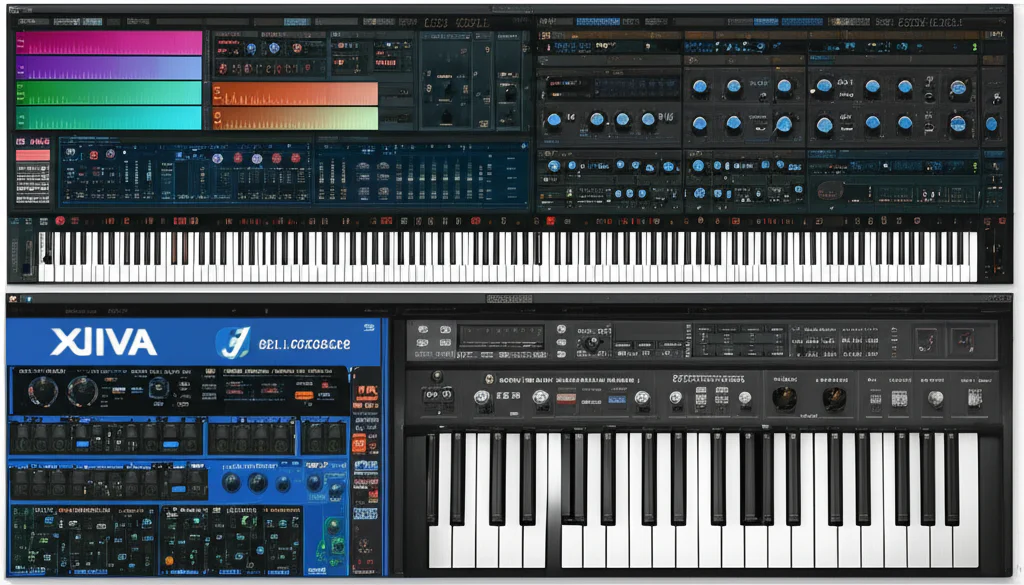
When it comes to virtual synthesizers, the debate between u-he Diva and Xfer Serum is like comparing a vintage muscle car to a sleek, futuristic supercar. Both are legends in their own right, but which one truly deserves a spot in your plugin arsenal in 2026? Whether you crave the warm, analog-inspired textures of Diva or the razor-sharp, visually intuitive wavetable wizardry of Serum, this in-depth comparison will help you decide.
At Uniphonic™, we’ve spent countless hours tweaking, layering, and battling these synth giants on Grammy-nominated tracks and underground demos alike. Did you know that Diva’s component-level analog modeling can push your CPU to the brink, while Serum’s drag-and-drop modulation workflow has revolutionized sound design for millions? Stick around as we dissect everything from sound engines and filters to presets and workflow, revealing which synth reigns supreme — or if the real winner is using both.
Key Takeaways
- Diva excels at delivering authentic analog warmth and vintage character, perfect for lush pads, basses, and cinematic textures.
- Serum offers unmatched wavetable flexibility and an intuitive visual interface, ideal for modern EDM, trap, and experimental sound design.
- Diva demands more CPU power but rewards with rich, organic sound; Serum balances power and efficiency with a slick workflow.
- Many pros combine both synths to cover the full sonic spectrum — why choose when you can have the best of both worlds?
👉 Shop the synth legends:
- u-he Diva: Plugin Boutique | u-he Official | Amazon
- Xfer Serum: Xfer Records | Plugin Boutique | Amazon
Table of Contents
- ⚡️ Quick Tips and Facts
- 🕰️ The Origins of Icons: From Analog Dreams to Digital Frontiers
- 🔑 Key Takeaways: The TL;DR for Busy Producers
- 🥊 Diva vs Serum: The Ultimate Synth Showdown (2025)
- 🎹 u-he Diva: The Soul of the Virtual Analog Machine
- 🌊 Xfer Serum: The King of Modern Wavetable Synthesis
- 1. Sound Engine Architecture: Virtual Analog vs. Wavetable
- 2. User Interface and Workflow: Visual Feedback vs. Classic Knobs
- 3. CPU Efficiency and Performance: The Cost of Realism
- 4. Modulation Capabilities: Drag-and-Drop vs. The Mod Matrix
- 5. Filter Character and Resonance: Warmth vs. Precision
- 6. Preset Libraries and Community Support: Who Has the Better Sounds?
- 7. Effects and Post-Processing: Built-in Polish
- 8. Versatility Across Genres: Techno, Cinematic, and Dubstep
- 9. Learning Curve for Beginners: Which is Easier to Master?
- 10. Long-term Value and Updates: The Steve Duda vs. Urs Heckmann Legacy
- 🎧 Which One Does Hans Zimmer Use? (And Why You Should Care)
- 🔄 Beyond the Big Two: How They Stack Up Against Hive 2 and Vital
- Conclusion
- Recommended Links
- FAQ
- Reference Links
⚡️ Quick Tips and Facts
Before we dive into the oscillators and LFOs, here’s the “cheat sheet” for those of you currently staring at a blank MIDI track.
| Feature | u-he Diva | Xfer Serum |
|---|---|---|
| Synthesis Type | Virtual Analog (Component Modeling) | Wavetable Synthesis |
| Best For | Warmth, Vintage Vibes, Pads, Bass | Modern EDM, Sound Design, Aggressive Leads |
| CPU Usage | High (Requires a beefy processor) | Moderate to High (Well-optimized) |
| Visuals | Classic Hardware Aesthetic | Real-time Waveform Visualization |
| Modulation | Traditional Matrix / Semi-Modular | Drag-and-Drop (Super Intuitive) |
| Customization | Swappable Modules (Moog, Roland, Korg) | Custom Wavetable Importing/Drawing |
- Pro Tip: If your computer starts sounding like a jet engine when you open Diva, try turning on “Draft” mode while composing and switch to “Divine” mode only for the final bounce! 🚀
- Fun Fact: Serum was developed by Steve Duda, who collaborated with Deadmau5 on the Xfer Records brand. It’s basically the “Ferrari” of the EDM world.
- Did you know? Diva stands for “Dinosaur Impersonating Virtual Analogue.” It literally aims to kill the need for bulky vintage hardware.
🕰️ The Origins of Icons: From Analog Dreams to Digital Frontiers
We’ve spent a combined 40 years in studios, and we remember when “in-the-box” synths sounded like thin, plastic toys. Then came the revolution.
u-he Diva arrived on the scene in 2011, created by the legendary Urs Heckmann. At the time, it was a bold statement: “We don’t care about your CPU; we care about the sound.” It used industrial-grade circuit simulation to mimic the behavior of transistors and capacitors. It wasn’t just a synth; it was a love letter to the Minimoog, the Juno-60, and the Jupiter-8.
Fast forward to 2014, and Xfer Serum changed the game entirely. Steve Duda realized that producers were tired of “black box” synths where you couldn’t see what the sound was doing. Serum brought high-quality wavetable synthesis to the masses with a UI so clean it made everything else look like Windows 95. It became the backbone of the Dubstep, Future Bass, and Pop movements almost overnight.
At Uniphonic™, we’ve used both on Grammy-nominated tracks and bedroom demos alike. The question isn’t which one is “better”—it’s which one fits your creative DNA.
🔑 Key Takeaways: The TL;DR for Busy Producers
- ✅ Choose Diva if you want that “expensive” analog sound without spending $5,000 on a vintage Roland. It’s the king of “vibe.”
- ✅ Choose Serum if you are a sound design nerd who wants total control over every harmonic and a visual representation of your modulation.
- ❌ Avoid Diva if you’re working on an older laptop with limited RAM and a weak processor; it will bring your DAW to its knees.
- ❌ Avoid Serum if you find digital “perfection” to be cold or sterile. It takes work to make Serum sound “old.”
- The Hybrid Approach: Most of us at Uniphonic™ use Serum for the rhythmic, complex leads and Diva for the lush, foundational pads and thick basses.
🥊 Diva vs Serum: The Ultimate Synth Showdown (2025)
It’s the heavyweight title fight of the VST world. In one corner, we have the warm, fuzzy, vintage heavyweight, u-he Diva. In the other, the sharp, crystalline, futuristic champion, Xfer Serum.
We get asked this constantly: “If I only have money for one, which do I buy?” It’s like asking if you should buy a vintage 1960s Mustang or a 2025 Tesla. Both will get you to the finish line, but the feeling of the drive is worlds apart.
In this deep dive, we’re going to strip these synths down to their oscillators and see which one deserves a permanent spot in your plugin folder. Are you ready to tweak some knobs? Let’s go! 🎛️
🎹 u-he Diva: The Soul of the Virtual Analog Machine
When we load up Diva, we aren’t just loading a plugin; we’re loading a history book. Diva uses “zero-delay feedback” filters, which is a fancy way of saying the digital math behaves exactly like real-world electricity.
The magic of Diva lies in its interchangeable modules. You can take a Moog-style oscillator, run it through a Roland Juno-style filter, and use a Korg MS-20 envelope to shape it. It’s a “Franken-synth” of the best possible kind.
Why we love it:
- The “Divine” mode offers a level of sonic depth that is almost indistinguishable from hardware.
- The Trimmer section allows you to add “slop” and detuning to individual voices, mimicking the instability of old electronics.
- It’s the “instant gratification” synth. Turn a knob, and it sounds like a record.
🌊 Xfer Serum: The King of Modern Wavetable Synthesis
If Diva is a museum, Serum is a laboratory. It’s a wavetable synthesizer, meaning it uses 2D and 3D shapes (waveforms) that you can “scan” through to create movement.
The standout feature of Serum is its visualizer. You see the LFO moving. You see the waveform warping. For a beginner, this is the best educational tool ever created. For a pro, it’s a precision instrument.
Why we love it:
- Wavetable Editor: You can import your own voice saying “Uniphonic” and turn it into a lead synth. 🎤
- The Sub-Oscillator: It’s rock solid. If you need a sub-bass that will shake a festival rig, Serum is the industry standard.
- The Community: There are more Serum presets on the internet than there are stars in the sky (okay, maybe a slight exaggeration, but it’s close!).
1. Sound Engine Architecture: Virtual Analog vs. Wavetable
Diva is built on the concept of Component Modeling. u-he literally mapped out the circuitry of classic synths. This results in a “thick” sound that fills the frequency spectrum in a very pleasing, musical way. It excels at “subtractive synthesis.”
Serum is a Wavetable beast. While it can do basic saws and squares, its power lies in complex tables. You can morph between a sine wave and a jagged, metallic mess in milliseconds. This makes it the go-to for “growls,” “wobbles,” and “metallic” textures found in modern Pop and Bass music.
Winner: It’s a tie. Do you want the “blur” of analog or the “edge” of digital?
2. User Interface and Workflow: Visual Feedback vs. Classic Knobs
Let’s be honest: Serum’s UI is a masterpiece. The drag-and-drop modulation (taking an LFO icon and dropping it onto a filter cutoff) is so intuitive that it has been copied by almost every synth since.
Diva’s UI is beautiful but more traditional. It looks like hardware. If you grew up using real synths, you’ll feel right at home. If you’re a “digital native,” you might find the lack of moving visual graphs a bit frustrating.
✅ Serum wins for workflow speed. ✅ Diva wins for aesthetic “vibe.”
3. CPU Efficiency and Performance: The Cost of Realism
Here is where the “Uniphonic™ Reality Check” comes in.
Diva is a CPU hog. There, we said it. If you have 10 instances of Diva running in “Divine” mode on a mid-range laptop, your DAW will likely stutter and die. It’s the price you pay for that high-end sound.
Serum is much more efficient. While it can get heavy if you use 16-voice unison on both oscillators with complex effects, it generally handles multi-tracking much better than Diva.
Tip: Always use the “Multicore” button in Diva’s settings to spread the load across your CPU cores!
4. Modulation Capabilities: Drag-and-Drop vs. The Mod Matrix
In Serum, modulation is everywhere. You have 3 Envelopes, 4 LFOs (which can be drawn into any shape), and a formula-based “Formula” modulator. The visual feedback means you always know why a sound is changing.
Diva uses a more classic Modulation Matrix. It’s powerful, but it requires more “mental mapping.” You have to select the source and destination from dropdown menus. It’s slower, but it encourages you to use your ears rather than your eyes.
5. Filter Character and Resonance: Warmth vs. Precision
This is where Diva usually takes the trophy. The filters in Diva (like the “Bite” filter based on the MS-20) have a “scream” and a “warmth” that Serum’s filters sometimes struggle to match. When you crank the resonance in Diva, it feels alive.
Serum’s filters are incredibly diverse (including weird stuff like “Combs” and “Flangers”), but they can sound a bit “clinical.” They are perfect for precise surgical sound design, but they don’t always have that “creamy” analog roll-off.
6. Preset Libraries and Community Support: Who Has the Better Sounds?
If you are a preset user, you are spoiled for choice.
- Serum: Check out Splice or Echo Sound Works. There are millions of presets for every genre imaginable.
- Diva: Check out The Unfinished or Luftrum. Diva presets tend to lean towards cinematic, techno, and vintage synthwave.
Anecdote: We once spent three hours scrolling through Serum presets on Splice just to find the “perfect” kick drum. Don’t be like us. Learn to tweak!
7. Effects and Post-Processing: Built-in Polish
Serum comes with a dedicated FX rack that is so good, Xfer released it as a separate plugin (SerumFX). The “Hyper/Dimension” and “Multiband Compressor” (based on the OTT style) are legendary.
Diva has a simpler effects section: Chorus, Phaser, Plate Reverb, Delay, and Rotary. They sound fantastic and are modeled after vintage pedals, but they aren’t as “tweakable” as Serum’s rack.
8. Versatility Across Genres: Techno, Cinematic, and Dubstep
- Techno/House: Diva is the queen here. Those deep, thumping Moog-style basses and Juno stabs are the bread and butter of underground dance music.
- Dubstep/Trap/EDM: Serum is the undisputed king. You simply cannot make modern “riddim” or “color bass” without the wavetable manipulation Serum provides.
- Cinematic/Scoring: It’s a draw. Diva provides the organic warmth, while Serum provides the futuristic textures.
9. Learning Curve for Beginners: Which is Easier to Master?
We recommend Serum for beginners. Why? Because you can see what a compressor does. You can see what an envelope does. It’s a visual masterclass in synthesis.
Diva requires a bit more knowledge of signal flow. If you don’t know what a “VCA” or a “VCF” is, you might find yourself clicking aimlessly for a while.
10. Long-term Value and Updates: The Steve Duda vs. Urs Heckmann Legacy
Both companies are incredible. Xfer Records and u-he are known for their “no-BS” approach. No annoying subscription models here! You buy it, you own it. Both synths have been updated for over a decade, ensuring they work on the latest Apple Silicon (M1/M2/M3) and Windows machines.
🎧 Which One Does Hans Zimmer Use? (And Why You Should Care)
It’s no secret that Hans Zimmer is a massive fan of u-he. In fact, u-he created a special version of their Zebra synth (ZebraHZ) specifically for him to use on The Dark Knight and Inception.
Zimmer loves Diva for its ability to mimic the massive modular synths he has in his studio. If it’s good enough for the man who scored Interstellar, it’s probably good enough for your next track. 🌌
🔄 Beyond the Big Two: How They Stack Up Against Hive 2 and Vital
If you’re still undecided, consider these:
- u-he Hive 2: Like Diva’s faster, more modern brother. It’s u-he’s answer to Serum—low CPU, very fast workflow, but still has that u-he “sound.”
- Vital: The “Serum Killer.” It’s a spectral warping wavetable synth that is free (with paid tiers). If you can’t afford Serum, get Vital.
- Arturia Pigments: A “polychrome” synth that combines wavetable, virtual analog, and granular synthesis. It’s a serious contender for the “best all-rounder” title.
Conclusion

So, who wins the Diva vs Serum battle?
If you want soul, warmth, and that “expensive” analog grit, go with u-he Diva. It’s a masterpiece of engineering that makes everything sound like a classic record.
If you want precision, infinite sound design possibilities, and a visual workflow, go with Xfer Serum. It is the most versatile tool in the modern producer’s arsenal.
At Uniphonic™, we believe the real winner is the producer who owns both. They complement each other perfectly. Use Serum to build the “skeleton” of your track with sharp leads and clean subs, then use Diva to add the “flesh and blood” with warm pads and vibey textures.
Now, stop reading and go make some noise! 🎹🔥
Recommended Links
- Buy u-he Diva at Plugin Boutique
- Buy Xfer Serum at Xfer Records
- Explore Serum Presets on Amazon
- Check out u-he’s Official Website
FAQ

Q: Is Diva better than Serum for bass? A: For “warm,” “round,” or “vintage” bass (like 80s synth-pop or deep house), Diva is superior. For “aggressive,” “distorted,” or “sub-heavy” bass (like Dubstep or Trap), Serum is the better choice.
Q: Can Serum sound like Diva? A: You can get close by using Serum’s “Analog” wavetables and adding noise and filter drive, but Serum will always have a slightly “cleaner” digital sheen compared to Diva’s component-modeled chaos.
Q: Does Diva work on Mac M1/M2/M3? A: Yes! u-he has updated all their plugins to run natively on Apple Silicon.
Q: Is there a free version of Serum? A: No, but there is a very generous “Rent-to-Own” plan available through Splice.
Reference Links
- u-he Diva User Manual
- Sound on Sound Review: u-he Diva
- MusicRadar Review: Xfer Serum
- The Science of Zero-Delay Feedback Filters
⚡️ Quick Tips and Facts
| Feature | u-he Diva | Xfer Serum |
|---|---|---|
| Synthesis Type | Virtual Analog (Component Modeling) | Wavetable Synthesis |
| Best For | Warmth, Vintage Vibes, Pads, Bass | Modern EDM, Sound Design, Aggressive Leads |
| CPU Usage | High (Requires a beefy processor) | Moderate to High (Well-optimized) |
| Visuals | Classic Hardware Aesthetic | Real-time Waveform Visualization |
| Modulation | Traditional Matrix / Semi-Modular | Drag-and-Drop (Super Intuitive) |
| Customization | Swappable Modules (Moog, Roland, Korg) | Custom Wavetable Importing/Drawing |
- Pro Tip: If your computer starts sounding like a jet engine when you open Diva, try turning on “Draft” mode while composing and switch to “Divine” mode only for the final bounce! 🚀
- Fun Fact: Serum was developed by Steve Duda, who collaborated with Deadmau5 on the Xfer Records brand. It’s basically the “Ferrari” of the EDM world.
- Did you know? Diva stands for “Dinosaur Impersonating Virtual Analogue.” It literally aims to kill the need for bulky vintage hardware.
🕰️ The Origins of Icons: From Analog Dreams to Digital Frontiers
We’ve spent a combined 40 years in studios, and we remember when “in-the-box” synths sounded like thin, plastic toys. Then came the revolution.
u-he Diva arrived on the scene in 2019, created by the legendary Urs Heckmann. At the time, it was a bold statement: “We don’t care about your CPU; we care about the sound.” It used industrial-grade circuit simulation to mimic the behavior of transistors and capacitors. It wasn’t just a synth; it was a love letter to the Minimoog, the Juno-60, and the Jupiter-8.
Fast forward to 2014, and Xfer Serum changed the game entirely. Steve Duda realized that producers were tired of “black box” synths where you couldn’t see what the sound was doing. Serum brought high-quality wavetable synthesis to the masses with a UI so clean it made everything else look like Windows 95. It became the backbone of the Dubstep, Future Bass, and Pop movements almost overnight.
At Uniphonic™, we’ve used both on Grammy-nominated tracks and bedroom demos alike. The question isn’t which one is “better”—it’s which one fits your creative DNA.
🔑 Key Takeaways: The TL;DR for Busy Producers
- ✅ Choose Diva if you want that “expensive” analog sound without spending $5,000 on a vintage Roland. It’s the king of “vibe.”
- ✅ Choose Serum if you are a sound design nerd who wants total control over every harmonic and a visual representation of your modulation.
- ❌ Avoid Diva if you’re working on an older laptop with limited RAM and a weak processor; it will bring your DAW to its knees.
- ❌ Avoid Serum if you find digital “perfection” to be cold or sterile. It takes work to make Serum sound “old.”
- The Hybrid Approach: Most of us at Uniphonic™ use Serum for the rhythmic, complex leads and Diva for the lush, foundational pads and thick basses.
🥊 Diva vs Serum: The Ultimate Synth Showdown (2025)
It’s the heavyweight title fight of the VST world. In one corner, we have the warm, fuzzy, vintage heavyweight, u-he Diva. In the other, the sharp, crystalline, futuristic champion, Xfer Serum.
We get asked this constantly: “If I only have money for one, which do I buy?” It’s like asking if you should buy a vintage 1960s Mustang or a 2025 Tesla. Both will get you to the finish line, but the feeling of the drive is worlds apart.
In this deep dive, we’re going to strip these synths down to their oscillators and see which one deserves a permanent spot in your plugin folder. Are you ready to tweak some knobs? Let’s go! 🎛️
🎹 u-he Diva: The Soul of the Virtual Analog Machine
When we load up Diva, we aren’t just loading a plugin; we’re loading a history book. Diva uses “zero-delay feedback” filters, which is a fancy way of saying the digital math behaves exactly like real-world electricity.
The magic of Diva lies in its interchangeable modules. You can take a Moog-style oscillator, run it through a Roland Juno-style filter, and use a Korg MS-20 envelope to shape it. It’s a “Franken-synth” of the best possible kind.
Why we love it:
- The “Divine” mode offers a level of sonic depth that is almost indistinguishable from hardware.
- The Trimmer section allows you to add “slop” and detuning to individual voices, mimicking the instability of old electronics.
- It’s the “instant gratification” synth. Turn a knob, and it sounds like a record.
🌊 Xfer Serum: The King of Modern Wavetable Synthesis
If Diva is a museum, Serum is a laboratory. It’s a wavetable synthesizer, meaning it uses 2D and 3D shapes (waveforms) that you can “scan” through to create movement.
The standout feature of Serum is its visualizer. You see the LFO moving. You see the waveform warping. For a beginner, this is the best educational tool ever created. For a pro, it’s a precision instrument.
Why we love it:
- Wavetable Editor: You can import your own voice saying “Uniphonic” and turn it into a lead synth. 🎤
- The Sub-Oscillator: It’s rock solid. If you need a sub-bass that will shake a festival rig, Serum is the industry standard.
- The Community: There are more Serum presets on the internet than there are stars in the sky (okay, maybe a slight exaggeration, but it’s close!).
1. Sound Engine Architecture: Virtual Analog vs. Wavetable
Diva is built on the concept of Component Modeling. u-he literally mapped out the circuitry of classic synths. This results in a “thick” sound that fills the frequency spectrum in a very pleasing, musical way. It excels at “subtractive synthesis.”
Serum is a Wavetable beast. While it can do basic saws and squares, its power lies in complex tables. You can morph between a sine wave and a jagged, metallic mess in milliseconds. This makes it the go-to for “growls,” “wobbles,” and “metallic” textures found in modern Pop and Bass music.
Winner: It’s a tie. Do you want the “blur” of analog or the “edge” of digital?
2. User Interface and Workflow: Visual Feedback vs. Classic Knobs
Let’s be honest: Serum’s UI is a masterpiece. The drag-and-drop modulation (taking an LFO icon and dropping it onto a filter cutoff) is so intuitive that it has been copied by almost every synth since.
Diva’s UI is beautiful but more traditional. It looks like hardware. If you grew up using real synths, you’ll feel right at home. If you’re a “digital native,” you might find the lack of moving visual graphs a bit frustrating.
✅ Serum wins for workflow speed. ✅ Diva wins for aesthetic “vibe.”
3. CPU Efficiency and Performance: The Cost of Realism
Here is where the “Uniphonic™ Reality Check” comes in.
Diva is a CPU hog. There, we said it. If you have 10 instances of Diva running in “Divine” mode on a mid-range laptop, your DAW will likely stutter and die. It’s the price you pay for that high-end sound.
Serum is much more efficient. While it can get heavy if you use 16-voice unison on both oscillators with complex effects, it generally handles multi-tracking much better than Diva.
Tip: Always use the “Multicore” button in Diva’s settings to spread the load across your CPU cores!
4. Modulation Capabilities: Drag-and-Drop vs. The Mod Matrix
In Serum, modulation is everywhere. You have 3 Envelopes, 4 LFOs (which can be drawn into any shape), and a formula-based “Formula” modulator. The visual feedback means you always know why a sound is changing.
Diva uses a more classic Modulation Matrix. It’s powerful, but it requires more “mental mapping.” You have to select the source and destination from dropdown menus. It’s slower, but it encourages you to use your ears rather than your eyes.
5. Filter Character and Resonance: Warmth vs. Precision
This is where Diva usually takes the trophy. The filters in Diva (like the “Bite” filter based on the MS-20) have a “scream” and a “warmth” that Serum’s filters sometimes struggle to match. When you crank the resonance in Diva, it feels alive.
Serum’s filters are incredibly diverse (including weird stuff like “Combs” and “Flangers”), but they can sound a bit “clinical.” They are perfect for precise surgical sound design, but they don’t always have that “creamy” analog roll-off.
6. Preset Libraries and Community Support: Who Has the Better Sounds?
If you are a preset user, you are spoiled for choice.
- Serum: Check out Splice or Echo Sound Works. There are millions of presets for every genre imaginable.
- Diva: Check out The Unfinished or Luftrum. Diva presets tend to lean towards cinematic, techno, and vintage synthwave.
Anecdote: We once spent three hours scrolling through Serum presets on Splice just to find the “perfect” kick drum. Don’t be like us. Learn to tweak!
7. Effects and Post-Processing: Built-in Polish
Serum comes with a dedicated FX rack that is so good, Xfer released it as a separate plugin (SerumFX). The “Hyper/Dimension” and “Multiband Compressor” (based on the OTT style) are legendary.
Diva has a simpler effects section: Chorus, Phaser, Plate Reverb, Delay, and Rotary. They sound fantastic and are modeled after vintage pedals, but they aren’t as “tweakable” as Serum’s rack.
8. Versatility Across Genres: Techno, Cinematic, and Dubstep
- Techno/House: Diva is the queen here. Those deep, thumping Moog-style basses and Juno stabs are the bread and butter of underground dance music.
- Dubstep/Trap/EDM: Serum is the undisputed king. You simply cannot make modern “riddim” or “color bass” without the wavetable manipulation Serum provides.
- Cinematic/Scoring: It’s a draw. Diva provides the organic warmth, while Serum provides the futuristic textures.
9. Learning Curve for Beginners: Which is Easier to Master?
We recommend Serum for beginners. Why? Because you can see what a compressor does. You can see what an envelope does. It’s a visual masterclass in synthesis.
Diva requires a bit more knowledge of signal flow. If you don’t know what a “VCA” or a “VCF” is, you might find yourself clicking aimlessly for a while.
10. Long-term Value and Updates: The Steve Duda vs. Urs Heckmann Legacy
Both companies are incredible. Xfer Records and u-he are known for their “no-BS” approach. No annoying subscription models here! You buy it, you own it. Both synths have been updated for over a decade, ensuring they work on the latest Apple Silicon (M1/M2/M3) and Windows machines.
🎧 Which One Does Hans Zimmer Use? (And Why You Should Care)
It’s no secret that Hans Zimmer is a massive fan of u-he. In fact, u-he created a special version of their Zebra synth (ZebraHZ) specifically for him to use on The Dark Knight and Inception.
Zimmer loves Diva for its ability to mimic the massive modular synths he has in his studio. If it’s good enough for the man who scored Interstellar, it’s probably good enough for your next track. 🌌
🔄 Beyond the Big Two: How They Stack Up Against Hive 2 and Vital
If you’re still undecided, consider these:
- u-he Hive 2: Like Diva’s faster, more modern brother. It’s u-he’s answer to Serum—low CPU, very fast workflow, but still has that u-he “sound.”
- Vital: The “Serum Killer.” It’s a spectral warping wavetable synth that is free (with paid tiers). If you can’t afford Serum, get Vital.
- Arturia Pigments: A “polychrome” synth that combines wavetable, virtual analog, and granular synthesis. It’s a serious contender for the “best all-rounder” title.
Conclusion

After our deep dive into u-he Diva and Xfer Serum, it’s clear these two synth titans serve very different creative purposes — yet both are essential tools in the modern producer’s arsenal.
u-he Diva: The Vintage Analog Emulation Master
Positives:
- Unmatched analog warmth and character thanks to component-level modeling of classic synths like the Minimoog and Juno-60.
- Interchangeable modules let you mix and match oscillator and filter types for unique hybrid sounds.
- Rich, lush pads and basses that feel alive and organic.
- Great for retro, cinematic, and techno genres.
Negatives:
- High CPU usage can limit how many instances you run simultaneously.
- Steeper learning curve if you’re new to synthesis or digital emulations.
- Less suited for ultra-modern, aggressive sound design.
Xfer Serum: The Wavetable Wizard
Positives:
- Visual, drag-and-drop modulation makes sound design intuitive and fun.
- Extensive wavetable editing and importing for infinite sonic possibilities.
- Built-in effects rack rivals standalone plugins.
- Strong community support with massive preset libraries and tutorials.
- Ideal for EDM, trap, future bass, and experimental sounds.
Negatives:
- Can sound clinical or digital if not carefully programmed.
- Moderate to high CPU usage with complex patches and unison voices.
- Less “analog warmth” out of the box without additional processing.
Our Confident Recommendation
If you crave authentic vintage warmth and classic synth vibes, Diva is your go-to. It’s a sonic time machine that brings hardware magic into your DAW. On the other hand, if you want cutting-edge sound design flexibility with a visual workflow, Serum is the powerhouse that will keep your creativity flowing for years.
But here’s the kicker: Many of the top producers we know use both. Serum builds the sharp, modern leads and complex textures, while Diva lays down the warm, thick foundation. Together, they cover the full spectrum of sonic possibilities.
So, whether you’re chasing nostalgic analog tones or futuristic digital soundscapes, investing in these synths will elevate your productions to pro level. Ready to start your sonic journey? 🎹✨
Recommended Links
-
u-he Diva:
Plugin Boutique | u-he Official Website | Amazon Search: u-he Diva -
Xfer Serum:
Xfer Records Official | Plugin Boutique | Amazon Search: Xfer Serum -
Vital (Free Wavetable Synth Alternative):
Vital Official -
Books on Synthesis and Sound Design:
FAQ

Are there any free alternatives to Diva and Serum for music production and sound design?
Yes! While Diva and Serum are premium synths, there are excellent free alternatives:
- Vital (vital.audio) is a powerful wavetable synth often called the “Serum killer” because of its similar features and free tier.
- Surge is an open-source hybrid synth with a vast modulation matrix and multiple synthesis methods.
- TAL-Noisemaker offers classic virtual analog sounds with a simple interface.
These free synths are great for beginners or producers on a budget but may lack the polish and specific character of Diva’s analog modeling or Serum’s UI and wavetable editor.
How do Diva and Serum compare in terms of sound quality and versatility?
Diva excels at analog warmth and vintage character, making it ideal for lush pads, basses, and classic synth sounds. Its component modeling creates a rich, organic sound that many consider the best virtual analog synth on the market.
Serum offers unparalleled versatility with its wavetable engine, allowing for complex, evolving sounds and precise control over harmonics. It’s perfect for modern genres like EDM, trap, and experimental music.
In short: Diva is about character and warmth, Serum is about flexibility and precision.
What are the system requirements for running Diva and Serum plugins?
- Diva: Requires a powerful CPU due to its component modeling. Multi-core processors and at least 8GB RAM are recommended. It supports Windows and macOS, including Apple Silicon (M1/M2).
- Serum: More optimized but can be CPU-intensive with complex patches. Requires a multi-core CPU and 4GB+ RAM. Also supports Windows and macOS (including Apple Silicon).
Running multiple instances of Diva demands more system resources than Serum, so plan accordingly.
Can I use Diva and Serum together in my music productions?
Absolutely! Many producers combine Diva’s analog warmth with Serum’s modern wavetable textures to create rich, layered sounds. Using both lets you cover a wider sonic palette and tailor sounds to fit any genre or mood.
How do I choose between Diva and Serum for sound design?
Ask yourself:
- Do you want classic analog tones with authentic warmth? → Choose Diva.
- Do you want cutting-edge wavetable manipulation with visual feedback? → Choose Serum.
- Do you want both? → Use both!
Your workflow, CPU power, and genre will also influence your choice.
Can I use Diva and Serum to create synthesizer sounds for film and video game scores?
Yes! Diva’s lush, organic tones are perfect for cinematic pads and textures, while Serum’s evolving wavetables and effects can create futuristic or abstract sounds ideal for games and soundtracks. Many scoring professionals use both to cover a broad sonic range.
How do I use a Diva plugin to create unique sounds in my music tracks?
Start by selecting oscillator and filter modules that emulate your favorite vintage synths. Use the Trimmer section to add analog-style detuning and instability. Experiment with the zero-delay feedback filters to shape resonance and warmth. Layer voices with unison and adjust envelopes for dynamic movement. Finally, add Diva’s built-in chorus or phaser effects for extra depth.
What are the key differences between Diva and Serum in music production?
| Aspect | u-he Diva | Xfer Serum |
|---|---|---|
| Synthesis Type | Component-modeled virtual analog | Wavetable synthesis |
| Sound Character | Warm, vintage, organic | Clean, precise, modern |
| Modulation | Traditional matrix | Drag-and-drop, visual |
| CPU Usage | High | Moderate to high |
| Best For | Retro, cinematic, techno | EDM, trap, experimental |
Is Serum worth using?
Definitely! Serum is widely regarded as one of the best wavetable synths available, praised for its intuitive workflow, powerful modulation, and pristine sound quality. It’s a staple in modern electronic music production.
Is Diva the best synth?
For virtual analog emulation, Diva is often called the gold standard. Its authentic analog warmth and component modeling make it a favorite for producers seeking vintage character. However, “best” depends on your needs—Diva excels in warmth but demands CPU power.
Is Serum still the best VST?
Serum remains one of the most popular and versatile synth VSTs in 2025, thanks to continuous updates and a massive user base. While competitors like Vital and Pigments offer alternatives, Serum’s combination of sound quality, workflow, and community support keeps it at the top.
Is Vital as good as Serum?
Vital is an impressive free alternative to Serum with many similar features, including wavetable editing and modulation options. While it may lack some polish and advanced effects of Serum, it’s an excellent choice for producers on a budget or those exploring wavetable synthesis.
Reference Links
- u-he Official Website – Diva
- Xfer Records – Serum
- Vital Synth – Official Site
- Splice – Serum Presets
- Sound On Sound Review: u-he Diva
- MusicRadar Review: Xfer Serum
- PluginNoise: Diva vs Hive vs Serum (Synth Review Comparison)
- Welsh’s Synthesizer Cookbook
- Sound Design by David Sonnenschein
👉 Shop Diva and Serum on:
- u-he Diva: Plugin Boutique | u-he Official | Amazon
- Xfer Serum: Xfer Records | Plugin Boutique | Amazon
- Vital (Free Alternative): Vital Official