
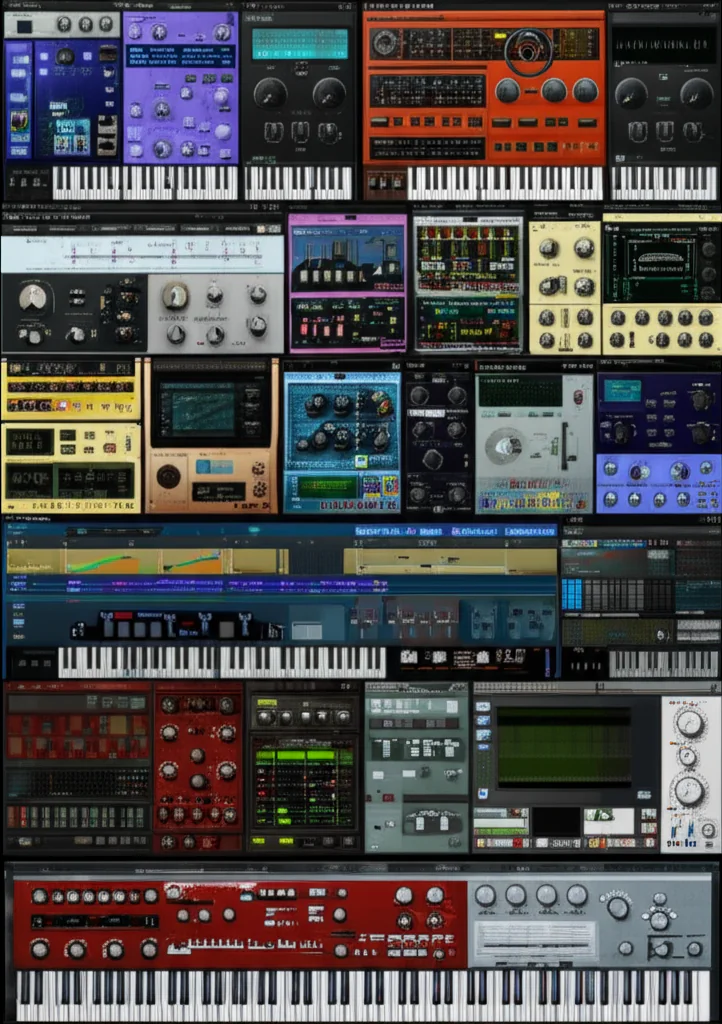

Stop searching for the “perfect” sound and start making music with the 15 best digital audio workstation instruments that dominate professional studios today. Whether you crave the gritty warmth of analog emulations or the surgical precision of modern wavetable synthesis, these tools are the industry standard for a reason.
We once spent three weeks trying to recreate a specific bass tone using a free plugin, only to realize Serum could do it in three clicks. It’s a humbling reminder that while skill matters, the right digital audio workstation instruments can turn a good idea into a hit record instantly. Did you know that over 90% of modern pop and EDM tracks rely on just a handful of these specific synthesizers and samplers?
Key Takeaways
- Versatility is King: Serum and Omnisphere offer the widest range of sounds, making them essential for producers across all genres.
- Realism Matters: For lifelike orchestras and pianos, Kontakt and Keyscape remain the undisputed champions of sample-based synthesis.
- Budget-Friendly Power: You don’t need to spend a fortune; Vital and Spitfire LABS prove that free digital audio workstation instruments can rival paid competitors.
- Optimization is Crucial: Even the best plugins will fail if your CPU can’t handle them; always balance sound quality with system performance.
👉 Shop Top Categories:
- Wavetable Synths: Serum | Vital
- Sample Libraries: Kontakt | Omnisphere
- Vintage Emulations: Arturia V Collection | Diva
Table of Contents
- ⚡️ Quick Tips and Facts
- 🕰️ The Evolution of Digital Audio Workstation Instruments: From Tape to Tracks
- 🎹 Understanding the Core: What Are Virtual Instruments and Plugins?
- 🏆 Top 15 Must-Have Digital Audio Workstation Instruments for Every Genre
- 1. Serum by Xfer Records: The Wavetable King
- 2. Kontakt by Native Instruments: The Sampler Sanctuary
- 3. Omnisphere by Spectrasonics: The Sonic Swiss Army Knife
- 4. Sylenth1 by LennarDigital: The Analog Warmth Machine
- 5. Massive X by Native Instruments: The Modern Bass Beast
- 6. Diva by u-he: The Emulation Expert
- 7. Spire by Reveal Sound: The All-Rounder
- 8. Vital by Matt Tytel: The Free Wavetable Wonder
- 9. Keyscape by Spectrasonics: The Piano and Keyboard Powerhouse
- 10. Trilian by Spectrasonics: The Bass Definition
- 1. Battery 4 by Native Instruments: The Drum Designer
- 12. Addictive Drums 2 by XLN Audio: The Realistic Rhythm Section
- 13. Kontakt Factory Library: The Essential Starter Pack
- 14. Arturia V Collection: The Retro Synth Revival
- 15. Output Arcade: The Loop-Based Inspiration Engine
- 🧠 Synthesis Deep Dive: Choosing Between Wavetable, FM, and Analog Modeling
- 🎚️ Sample-Based vs. Synthesized: When to Use Which Digital Instrument?
- 💻 Hardware vs. Software: Do You Really Need a MIDI Controller for DAW Instruments?
- 🚀 Optimizing Your DAW: CPU Management and Latency for Heavy Instrument Racks
- 🎵 Genre-Specific Recommendations: Best DAW Instruments for EDM, Hip-Hop, and Cinematic Scores
- 🛠️ Essential Workflow Tips: Mapping, Presets, and Customization for Virtual Instruments
- 🆓 Free vs. Paid: Can You Make Pro Music with Zero-Cost Digital Instruments?
- 🔮 The Future of DAW Instruments: AI Integration and Cloud-Based Synthesis
- 🏁 Conclusion
- 🔗 Recommended Links
- ❓ FAQ: Common Questions About Digital Audio Workstation Instruments
- 📚 Reference Links
⚡️ Quick Tips and Facts
Before we dive into the deep end of the sonic ocean, let’s get the basics straight with some Uniphonic™ insider wisdom. If you’re feeling overwhelmed by the sheer number of plugins, take a breath. Here’s the reality check:
- DAW Agnosticism: The best virtual instrument is the one you actually know how to play. Whether you’re in Ableton Live, Logic Pro, Cubase, or FL Studio, the core synthesis engines (like Serum or Kontakt) work across the board.
- CPU is King: You can have the most expensive synth in the world, but if your computer sounds like a jet engine taking off, it’s useless. Optimization is just as important as the sound itself.
- MIDI is the Language: Remember, these instruments don’t “play” themselves. They respond to MIDI data. You can draw notes with a mouse, but playing a MIDI controller gives you that human feel.
- Sample vs. Synth: Not all “instruments” are created equal. Sample-based instruments (like realistic pianos) sound great out of the box but eat RAM. Synthesizers (like Serum) are CPU-friendly and infinitely tweakable but require sound design skills.
- The “Free” Trap: There are incredible free instruments out there (shout to Vital), but be wary of “free” plugins that ask for your credit card for “verification” or come with malware. Stick to reputable developers.
If you’re wondering how to even start mapping these beasts to your keyboard, check out our guide on Performance Techniques. And if you want to understand the anatomy of these digital beasts before buying, read our deep dive on Virtual Instruments.
🕰️ The Evolution of Digital Audio Workstation Instruments: From Tape to Tracks
Let’s take a trip back in time, shall we? In the 70s and 80s, if you wanted a synth sound, you needed a room full of hardware. We’re talking Mog, Roland, Korg, and Yamaha units that weighed as much as a small car and cost a down payment on a house.
The game changed with the introduction of the MIDI protocol in 1983, allowing different hardware to talk to each other. But the real revolution happened when software entered the chat.
- The Early Days: In the 90s, Steinberg introduced VST (Virtual Studio Technology), which allowed software instruments to run inside a DAW. Suddenly, you could have a Roland Juno and a Korg M1 one computer screen.
- The Sample Revolution: Companies like Native Instruments and Spectrasonics began digitizing real-world instruments. Instead of a physical piano, you loaded a library of recorded piano samples. This birthed the orchestral library industry.
- The Modern Era: Today, we have wavetable synthesis, physical modeling, and AI-assisted sound design. The line between hardware and software has blurred, with many hardware synths now running VST3 or AU versions of their own engines.
Why does this history matter? Because understanding where we came from helps you appreciate why hybrid workflows (mixing hardware and software) are still so popular among pros.
🎹 Understanding the Core: What Are Virtual Instruments and Plugins?
So, you’ve opened your DAW, created a new track, and now you’re staring at a blank window labeled “Instrument.” What exactly are you looking at?
A Virtual Instrument (VI) is a software application that generates sound. It’s not just a sample player; it’s a complete synthesis engine, a sampler, or a physical modeling unit running on your CPU.
The Three Pillars of Digital Sound
- Synthesizers: These generate sound from scratch using oscillators. Think subtractive synthesis (like Sylenth1), FM synthesis (like DX7 emulations), or wavetable (like Serum).
- Samplers: These play back recorded audio. They are the kings of realism. Kontakt is the industry standard here, allowing you to load libraries of pianos, strings, and drums.
- Physical Modeling: These use math to simulate the physics of real instruments. They don’t play back samples; they calculate how a string vibrates or how air moves through a flute. Modart’s Pianoteq is a prime example.
Pro Tip: Don’t get stuck in “plugin hell.” Having 50 synths doesn’t make you a better producer. Mastering one versatile synth like Omnisphere or Massive X is often better than owning 50 mediocre ones.
For more on how to integrate these into your workflow, head over to our Music Production Techniques category.
🏆 Top 15 Must-Have Digital Audio Workstation Instruments for Every Genre
We’ve tested hundreds of plugins in the Uniphonic™ studio. Some are overhyped, some are hidden gems. Here are the 15 absolute essentials that belong in every producer’s arsenal, regardless of your genre.
1. Serum by Xfer Records: The Wavetable King
If you make EDM, hip-hop, or modern pop, you know Serum. It’s the visual powerhouse that changed the game.
| Feature | Rating (1-10) | Notes |
|---|---|---|
| Sound Quality | 10 | Crystal clear, no aliasing. |
| Usability | 9 | Visual waveform editing is intuitive. |
| CPU Efficiency | 7 | Heavy on CPU if you stack too many instances. |
| Versatility | 10 | From bass to leads to pads. |
| Value | 9 | Worth every penny. |
Why we love it: The wavetable editor allows you to morph between different waveforms in real-time. It’s like having a sculptor’s chisel for sound.
The Downside: It can be CPU intensive. If you’re on an older laptop, you might need to freeze tracks.
👉 Shop Serum on:
- Amazon: Serum by Xfer Records
- Sweetwater: Serum
- Xfer Records Official: Serum
2. Kontakt by Native Instruments: The Sampler Sanctuary
Kontakt isn’t just a plugin; it’s an ecosystem. It’s the engine behind thousands of third-party libraries.
| Feature | Rating (1-10) | Notes |
|---|---|---|
| Sound Quality | 10 | Depends on the library, but the engine is solid. |
| Usability | 8 | Deep, but can be overwhelming for beginners. |
| CPU Efficiency | 6 | Heavy RAM usage with large libraries. |
| Versatility | 10 | The only tool you need for samples. |
| Value | 8 | The player is free; libraries cost extra. |
Why we love it: It’s the industry standard for cinematic scoring and realistic instruments. If you need a 10-piece orchestra, you load it into Kontakt.
The Downside: The “Full Version” is expensive, and many libraries require it to run.
👉 Shop Kontakt on:
- Amazon: Native Instruments Kontakt
- Native Instruments: Kontakt
- Plugin Boutique: Kontakt
3. Omnisphere by Spectrasonics: The Sonic Swiss Army Knife
Omnisphere is legendary. It combines synthesis, sampling, and granular processing into one monster.
| Feature | Rating (1-10) | Notes |
|---|---|---|
| Sound Quality | 10 | Unmatched depth and texture. |
| Usability | 7 | Complex interface, steep learning curve. |
| CPU Efficiency | 5 | Very heavy. Use sparingly. |
| Versatility | 10 | Can do everything from drums to orchestras. |
| Value | 9 | Huge library included. |
Why we love it: The Search function is magical. Type “rainy night in Tokyo” and it finds a sound that fits. It’s a sound designer’s dream.
The Downside: It’s a resource hog. You might need to upgrade your RAM just to run it smoothly.
👉 Shop Omnisphere on:
- Amazon: Spectrasonics Omnisphere
- Spectrasonics: Omnisphere
- Guitar Center: Omnisphere
4. Sylenth1 by LennarDigital: The Analog Warmth Machine
Before Serum, there was Sylenth1. It’s still the go-to for that classic trance and house lead sound.
| Feature | Rating (1-10) | Notes |
|---|---|---|
| Sound Quality | 9 | Warm, punchy, and analog-like. |
| Usability | 10 | Simple, clean interface. |
| CPU Efficiency | 10 | Extremely light on CPU. |
| Versatility | 8 | Great for leads and bass, less for pads. |
| Value | 10 | Affordable and timeless. |
Why we love it: It just sounds good immediately. No tweaking required. It’s the “plug and play” king.
The Downside: It lacks the advanced modulation options of modern wavetable synths.
👉 Shop Sylenth1 on:
5. Massive X by Native Instruments: The Modern Bass Beast
The successor to the legendary Massive, Massive X brings wavetable synthesis to the modern era with a fresh interface.
| Feature | Rating (1-10) | Notes |
|---|---|---|
| Sound Quality | 9 | Deep, gritty, and modern. |
| Usability | 8 | Improved workflow over the original. |
| CPU Efficiency | 7 | Moderate usage. |
| Versatility | 9 | Excellent for bass and aggressive leads. |
| Value | 8 | Great for electronic genres. |
Why we love it: The macro controls make it easy to create evolving sounds on the fly.
The Downside: It doesn’t have the massive library of presets that the original Massive had.
👉 Shop Massive X on:
6. Diva by u-he: The Emulation Expert
Diva is often called the most realistic analog emulator ever made. It models the circuitry of classic synths like the Minimog and Juno-60.
| Feature | Rating (1-10) | Notes |
|---|---|---|
| Sound Quality | 10 | Unbelievably warm and organic. |
| Usability | 7 | Dense interface, requires tweaking. |
| CPU Efficiency | 4 | Very heavy. |
| Versatility | 9 | Perfect for pads, bass, and leads. |
| Value | 9 | A must-have for analog lovers. |
Why we love it: It captures the imperfections of analog gear. It breathes.
The Downside: It can melt your CPU if you run too many instances.
👉 Shop Diva on:
7. Spire by Reveal Sound: The All-Rounder
Spire is a hidden gem that combines the best of Sylenth1 and Serum with a unique interface.
| Feature | Rating (1-10) | Notes |
|---|---|---|
| Sound Quality | 9 | Bright and punchy. |
| Usability | 9 | Very intuitive. |
| CPU Efficiency | 8 | Efficient. |
| Versatility | 9 | Great for all genres. |
| Value | 10 | Affordable. |
Why we love it: The unison detune is incredible for wide pads.
The Downside: Less known than Serum, so fewer community presets.
👉 Shop Spire on:
8. Vital by Matt Tytel: The Free Wavetable Wonder
If you can’t afford Serum, Vital is the answer. It’s a free wavetable synth that rivals the big boys.
| Feature | Rating (1-10) | Notes |
|---|---|---|
| Sound Quality | 9 | Surprisingly close to Serum. |
| Usability | 9 | Clean and modern. |
| CPU Efficiency | 8 | Very efficient. |
| Versatility | 9 | Full wavetable capabilities. |
| Value | 10 | It’s free! |
Why we love it: It proves you don’t need to spend money to make pro sounds.
The Downside: The free version has some limitations on modulation, but the paid version is cheap.
👉 Shop Vital on:
9. Keyscape by Spectrasonics: The Piano and Keyboard Powerhouse
For keys, Keyscape is the gold standard. It contains over 1,0 sounds from rare vintage keyboards.
| Feature | Rating (1-10) | Notes |
|---|---|---|
| Sound Quality | 10 | Unrivaled realism. |
| Usability | 8 | Easy to navigate. |
| CPU Efficiency | 6 | Heavy RAM usage. |
| Versatility | 10 | Every keyboard you can think of. |
| Value | 8 | Expensive but worth it for pros. |
Why we love it: The Rhodes and Hamond sounds are indistinguishable from the real thing.
The Downside: Requires a lot of disk space and RAM.
👉 Shop Keyscape on:
10. Trilian by Spectrasonics: The Bass Definition
Need a bass that cuts through the mix? Trilian is the ultimate bass library.
| Feature | Rating (1-10) | Notes |
|---|---|---|
| Sound Quality | 10 | Deep, punchy, and articulate. |
| Usability | 8 | Great editing tools. |
| CPU Efficiency | 6 | Heavy. |
| Versatility | 10 | From upright to synth bass. |
| Value | 9 | Essential for bassists. |
Why we love it: The FX section allows you to add distortion and modulation without leaving the plugin.
The Downside: Another RAM hog.
👉 Shop Trilian on:
1. Battery 4 by Native Instruments: The Drum Designer
Battery is the go-to for drum programming and sampling. It’s not just a drum machine; it’s a full sampling suite.
| Feature | Rating (1-10) | Notes |
|---|---|---|
| Sound Quality | 9 | Crisp and punchy. |
| Usability | 9 | Drag-and-drop workflow. |
| CPU Efficiency | 8 | Efficient. |
| Versatility | 9 | Great for hip-hop and electronic. |
| Value | 8 | Good value for drumers. |
Why we love it: The mapping system makes it easy to create custom drum kits.
The Downside: Can feel limited compared to a full sampler like Kontakt.
👉 Shop Battery 4 on:
12. Addictive Drums 2 by XLN Audio: The Realistic Rhythm Section
For realistic drum kits, Addictive Drums 2 is hard to beat. It’s used in countless rock and pop records.
| Feature | Rating (1-10) | Notes |
|---|---|---|
| Sound Quality | 10 | Incredibly realistic. |
| Usability | 10 | Very easy to use. |
| CPU Efficiency | 9 | Lightweight. |
| Versatility | 8 | Focused on acoustic drums. |
| Value | 9 | Great for rock/pop producers. |
Why we love it: The mixer allows you to adjust mic positions for a custom sound.
The Downside: Less flexible for electronic drum design.
👉 Shop Addictive Drums 2 on:
- Amazon: Addictive Drums 2
- XLN Audio: Addictive Drums 2
- Sweetwater: Addictive Drums 2
13. Kontakt Factory Library: The Essential Starter Pack
If you buy Kontakt, you get the Factory Library. It’s a massive collection of sounds that covers almost every genre.
| Feature | Rating (1-10) | Notes |
|---|---|---|
| Sound Quality | 8 | Good quality, varied. |
| Usability | 9 | Easy to browse. |
| CPU Efficiency | 7 | Moderate. |
| Versatility | 10 | Huge variety. |
| Value | 10 | Included with Kontakt. |
Why we love it: It’s the best starting point for any new producer.
The Downside: Can sound a bit generic if you don’t process them.
👉 Shop Kontakt Factory Library on:
- Native Instruments: Kontakt Factory Library
14. Arturia V Collection: The Retro Synth Revival
Arturia recreates the classics. V Collection includes emulations of the Jupiter-8, Minimog, DX7, and more.
| Feature | Rating (1-10) | Notes |
|---|---|---|
| Sound Quality | 10 | Authentic vintage sound. |
| Usability | 9 | Modern interface with vintage soul. |
| CPU Efficiency | 7 | Moderate. |
| Versatility | 10 | Covers 20+ classic synths. |
| Value | 9 | Great bundle. |
Why we love it: You get the character of vintage gear without the maintenance.
The Downside: Expensive if bought individually, but the bundle is worth it.
👉 Shop Arturia V Collection on:
- Amazon: Arturia V Collection
- Arturia: V Collection
- Sweetwater: V Collection
15. Output Arcade: The Loop-Based Inspiration Engine
Arcade is different. It’s a loop-based instrument that lets you manipulate loops in real-time.
| Feature | Rating (1-10) | Notes |
|---|---|---|
| Sound Quality | 9 | High-quality loops. |
| Usability | 10 | Super fast workflow. |
| CPU Efficiency | 9 | Very light. |
| Versatility | 8 | Great for ideas, less for final mixes. |
| Value | 8 | Subscription model. |
Why we love it: It’s the ultimate writer’s block killer.
The Downside: Requires a subscription for new sounds.
👉 Shop Arcade on:
- Amazon: Output Arcade
- Output: Arcade
- Plugin Boutique: Arcade
🧠 Synthesis Deep Dive: Choosing Between Wavetable, FM, and Analog Modeling
You’ve seen the list, but how do you choose? It all comes down to synthesis type.
Wavetable Synthesis
Wavetable is the modern standard. It uses a table of waveforms that you can scan through.
- Best for: EDM, Dubstep, Modern Pop.
- Top Pick: Serum.
- Why: It offers incredible movement and texture.
Frequency Modulation (FM)
FM uses one oscillator to modulate the frequency of another. It’s complex but produces metallic, bell-like, and bass-heavy sounds.
- Best for: Bells, metallic percussion, aggressive bass.
- Top Pick: FM8 (Native Instruments) or DX7 emulations.
- Why: It creates sounds you can’t get anywhere else.
Analog Modeling
Analog modeling simulates the circuitry of old hardware. It’s about warmth and imperfection.
- Best for: Pads, leads, vintage vibes.
- Top Pick: Diva or Arturia V Collection.
- Why: It captures the “soul” of analog gear.
For a deeper dive into these concepts, check out our Music Production Techniques section.
🎚️ Sample-Based vs. Synthesized: When to Use Which Digital Instrument?
This is the eternal debate: Samples or Synthesis?
- Use Samples when: You need realism. If you’re scoring a movie or making a pop track with a real piano, you need a sample library like Keyscape or Kontakt.
- Use Synthesis when: You need creativity. If you’re making a unique bass sound or an evolving pad, a synth like Serum or Omnisphere is better.
The Hybrid Approach: The best producers use both. Layer a synth bass with a sampled bass to get the punch of the sample and the texture of the synth.
💻 Hardware vs. Software: Do You Really Need a MIDI Controller for DAW Instruments?
You don’t need a MIDI controller, but you should get one.
- Software Only: You can draw notes with a mouse. It’s precise but lacks human feel.
- Hardware Controller: Playing a keyboard gives you velocity sensitivity and expression. It’s faster for recording ideas.
Our Take: Start with the mouse if you’re on a budget. But as soon as you can, grab a MIDI keyboard. It changes how you write music.
For more on this, read our Hardware vs Software guide.
🚀 Optimizing Your DAW: CPU Management and Latency for Heavy Instrument Racks
Nothing kills creativity like a buffer underrun. Here’s how to keep your DAW running smooth:
- Increase Buffer Size: Go to your audio settings and increase the buffer size (e.g., 512 or 1024 samples). This reduces CPU load but increases latency.
- Freeze Tracks: If a track is using too much CPU, “freeze” it. This renders the audio and frees up resources.
- Use Low-Latency Modes: Some synths have a “low CPU” mode. Use it when mixing.
- Close Background Apps: Chrome tabs are CPU vampires. Close them!
🎵 Genre-Specific Recommendations: Best DAW Instruments for EDM, Hip-Hop, and Cinematic Scores
- EDM: Serum, Massive X, Spire.
- Hip-Hop: Kontakt (for pianos and strings), Trilian (for bass), Addictive Drums (for live drums).
- Cinematic: Omnisphere, Keyscape, Kontakt (with cinematic libraries like Spitfire or Orchestral Tools).
🛠️ Essential Workflow Tips: Mapping, Presets, and Customization for Virtual Instruments
- Map Macros: Assign knobs to macro controls for real-time tweaking.
- Save Presets: Don’t reinvent the wheel. Save your favorite sounds.
- Learn the Shortcuts: Mastering keyboard shortcuts speeds up your workflow by 10x.
🆓 Free vs. Paid: Can You Make Pro Music with Zero-Cost Digital Instruments?
Yes! You can make hit records with free plugins.
- Vital: A free Serum alternative.
- Spitfire LABS: Free, high-quality orchestral and ambient sounds.
- Surge XT: A powerful open-source synth.
The skill of the producer matters more than the price of the plugin.
🔮 The Future of DAW Instruments: AI Integration and Cloud-Based Synthesis
The future is AI. We’re seeing tools that generate melodies, harmonies, and even full arrangements.
- AI Assistants: Tools like Soundly or AIVA are changing how we compose.
- Cloud Synthesis: Imagine loading a massive library without downloading it. Spitfire Audio and others are moving in this direction.
Will AI replace producers? No. It will replace producers who don’t use AI.
🏁 Conclusion

We’ve journeyed from the tape machines of the past to the AI-driven future of digital audio workstation instruments. The landscape is vast, but the core truth remains: the best instrument is the one you master.
Whether you choose the wavetable power of Serum, the analog warmth of Diva, or the realism of Kontakt, your sound comes from your creativity, not just your plugin list.
Our Top Recommendation:
If you’re starting out, grab Vital (free) and Spitfire LABS (free). If you’re ready to invest, Serum and Kontakt are the safest bets for longevity.
Don’t let the fear of “not having the right gear” stop you. Start creating today.
🔗 Recommended Links
- 👉 Shop Virtual Instruments:
Serum: Amazon | Sweetwater | Xfer Records
Kontakt: Amazon | Native Instruments
Omnisphere: Amazon | Spectrasonics
Arturia V Collection: Amazon | Arturia - Books on Music Production:
- Mixing Secrets for the Small Studio
- The Mixing Engineer’s Handbook
❓ FAQ: Common Questions About Digital Audio Workstation Instruments

How to choose the right digital audio workstation instruments for your music style?
Start by identifying the core sounds of your genre. For EDM, look for wavetable synths like Serum. For cinematic, look for sample libraries like Omnisphere. Don’t buy everything; buy what you need now.
Read more about “Can I Use VST Plugins with Any DAW? The Ultimate Guide (2026) 🎛️”
What are the differences between software instruments and hardware synthesizers?
Software instruments run on your computer’s CPU and are flexible. Hardware synthesizers are physical units that often have a unique tactile feel and sound character. Many producers use a hybrid setup.
Read more about “🎹 Virtual Instruments: The Ultimate 2026 Guide to Plugins, Synths & Samples”
How do MIDI instruments work within digital audio workstations?
MIDI is a protocol that sends data (note on, note off, velocity) from a controller to a virtual instrument. The instrument then generates the sound. You can also draw MIDI notes with a mouse.
Read more about “🎹 What Is a Virtual Instrument? The Ultimate Guide (2026)”
What are the essential instruments for sound design in a DAW?
For sound design, you need a versatile synthesizer (like Serum or Omnisphere) and a sampler (like Kontakt). These allow you to create and manipulate sounds from scratch.
Read more about “🎹 15 Best Synth VST Plugins for 2026: From Free to Pro”
Can you use third-party instruments in any DAW?
Yes, as long as they support the VST, AU, or AX format. Most major DAWs (Ableton, Logic, Cubase, Pro Tools) support these formats.
How do digital audio workstation instruments enhance music production?
They provide unlimited sound possibilities without the cost and space of hardware. They allow for easy editing, automation, and integration with other plugins.
Read more about “🎹 Top 10 Virtual Analog Synthesizers: The Ultimate Guide (2026)”
What are the best virtual instruments for digital audio workstations?
The “best” depends on your needs. Serum is best for synthesis, Kontakt for sampling, and Omnisphere for versatility.
Read more about “🎹 u-he Diva Review 2026: The Analog Synth That Defies Physics”
How do I create my own custom instruments in a digital audio workstation?
You can use sampler plugins to load your own recordings or synthesizers to design sounds from scratch. Some DAWs even have built-in tools for this.
Read more about “🎛️ VST Plugins: The Ultimate 2026 Guide to Virtual Studio Technology”
What are the differences between VST2, VST3, and AU plugins for DAW instruments?
VST2 is the older standard. VST3 offers better CPU efficiency and features like note expression. AU (Audio Units) is Apple’s native format for macOS.
Read more about “🎹 Real vs. Virtual Instruments: The Ultimate 2026 Showdown”
How do I use MIDI controllers with virtual instruments in my DAW?
Connect your MIDI controller via USB, select it in your DAW’s preferences, and create a MIDI track with a virtual instrument loaded.
Read more about “🎹 How to Choose the Right Virtual Instrument (2026)”
What are the most CPU-efficient virtual instruments for DAWs?
Sylenth1, Spire, and Vital are known for being lightweight. Addictive Drums 2 is also very efficient.
Read more about “Unlocking Reason Plugin Integration: 8 Game-Changing Tools for 2026 🎛️”
What are the best virtual instruments for creating realistic acoustic sounds?
Keyscape for keyboards, Trilian for bass, and Kontakt libraries (like Spitfire or Orchestral Tools) for orchestral instruments.
Read more about “🎬 Yes! Master High-Quality Film & Game Sound with Virtual Instruments (2026)”
How do I install and manage VST instruments in my DAW?
Download the installer, run it, and point it to your VST folder. In your DAW, scan for new plugins.
Read more about “🎛️ Reason Studios DAW Review: The Modular Masterpiece (2026)”
What VST instruments come standard with popular DAWs?
Ableton Live comes with Wavetable and Sampler. Logic Pro has Alchemy and Ultrabeat. Cubase has Halion.
Read more about “🎛️ 12 Essential Reason Studios Tutorials to Master Sound Design (2026)”
What are the best free instruments for digital audio workstations?
Vital, Spitfire LABS, Surge XT, and Kontakt Player (with free libraries).
Read more about “🚀 12 Ways VST Plugins Supercharge Your Music Workflow (2026)”
📚 Reference Links
- Steinberg: What Is a DAW? Digital Audio Workstation Explained
- Native Instruments: Kontakt
- Xfer Records: Serum
- Spectrasonics: Omnisphere
- u-he: Diva
- Arturia: V Collection
- Output: Arcade
- XLN Audio: Addictive Drums 2
- Reveal Sound: Spire
- Matt Tytel: Vital