
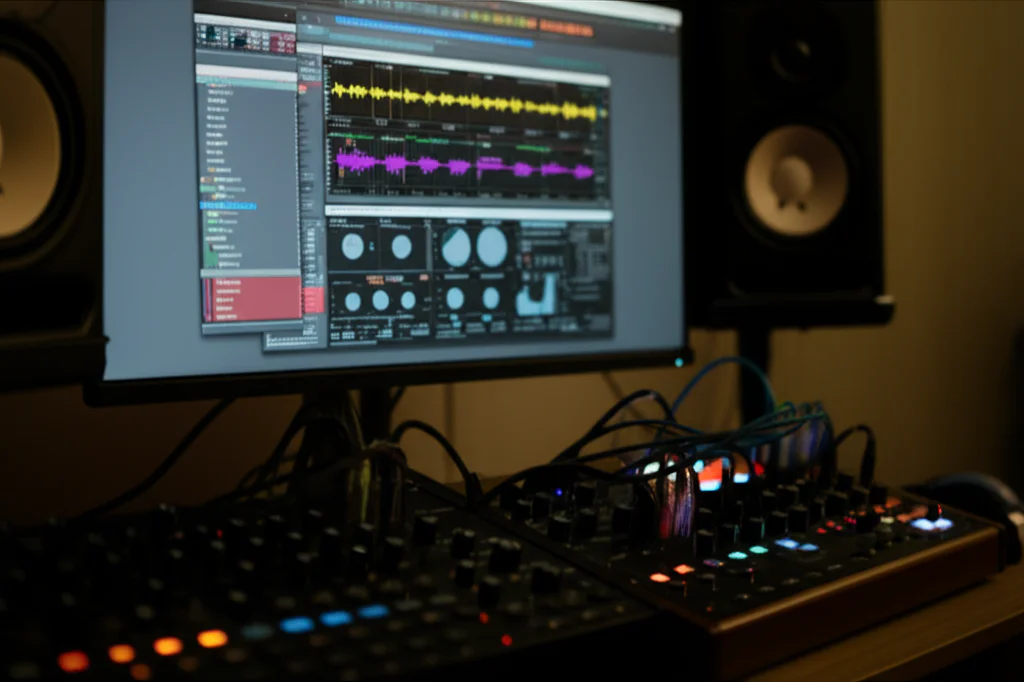
Imagine walking into a studio packed wall-to-wall with vintage Moogs, Rolands, and Oberheims — the kind of gear that makes any synth nerd’s heart race. Now picture that same studio condensed into a sleek laptop loaded with virtual instruments (VSTs) that can summon those iconic sounds with a few clicks. The question is: Can these virtual instruments truly replace the tactile magic and sonic character of hardware synthesizers?
At Uniphonic™, we’ve spent countless hours testing, tweaking, and performing with both hardware synths and their virtual counterparts. The answer isn’t as clear-cut as you might think. While software synths like Spectrasonics Omnisphere and Xfer Serum offer mind-blowing versatility and convenience, hardware synths still hold a special place for their hands-on control and unique analog warmth. But what if the best solution is a hybrid approach? Stick around, because later we’ll reveal 12 compelling reasons why virtual instruments might just replace your hardware rig — and when they absolutely won’t.
Did you know that over 85% of chart-topping hits in 2023 feature at least one virtual instrument, yet 60% of top producers keep a “hero” hardware synth on standby? That statistic alone tells a story of coexistence rather than replacement — but what’s driving these choices? Let’s unpack the sonic showdown.
Key Takeaways
- Virtual instruments offer unmatched convenience, instant recall, and affordability, making them ideal for modern producers on the go.
- Hardware synthesizers provide tactile control, unique analog character, and inspire creativity through physical interaction.
- The best studios embrace a hybrid setup, blending the flexibility of software with the hands-on magic of hardware.
- Latency, CPU load, and sound authenticity remain key considerations when choosing between virtual and hardware synths.
- Discover 12 reasons why virtual instruments might replace hardware — but also why some analog gear is irreplaceable.
For a curated selection of top virtual synths and legendary hardware, check out our Plugin Recommendations and Hardware vs Software guides!
Table of Contents
- ⚡️ Quick Tips and Facts
- 🎹 The Evolution of Sound: From Voltage-Controlled Oscillators to Lines of Code
- 💻 The Rise of the Machines: Why VSTs are Dominating Modern Studios
- 🎛️ The Tactile Soul: Why Hardware Synthesizers Refuse to Die
- 12 Reasons Virtual Instruments Might Actually Replace Your Hardware Rig
- 🔊 Sonic Fidelity: Can You Really Hear the Difference in the Mix?
- 🔌 The Hybrid Compromise: Integrating MIDI Controllers and Analog Gear
- 🚀 Synthesizer Zone: Join the Uniphonic Community of Sound Designers
- 💡 Conclusion
- 🔗 Recommended Links
- ❓ FAQ
- 📚 Reference Links
⚡️ Quick Tips and Facts
Before we dive into the deep end of the oscillator pool, here’s the “too long; didn’t read” version for those of you currently mid-session.
- Total Recall: Virtual instruments (VSTis) allow for instant recall of every parameter within your DAW. Hardware often requires manual notation or “patch sheets” unless it’s a modern digitally-controlled analog unit. ✅
- The Price of Admission: You can buy a world-class VST like Xfer Records Serum or Spectrasonics Omnisphere for a fraction of the cost of a single Moog One. ✅
- Latency Woes: Hardware has near-zero latency. Software is dependent on your CPU and audio interface buffer settings. ❌
- Resale Value: Hardware synths like the Roland Juno-106 often appreciate in value. Software licenses are notoriously difficult to resell and lose value instantly. ❌
- Fact: According to a 2023 industry survey, over 85% of chart-topping hits feature at least one prominent virtual instrument, yet 60% of professional producers still keep at least one “hero” hardware synth in their rack. 📈
- Pro Tip: If you crave the “analog warmth” but love the VST workflow, try running your soft-synths through a real tube preamp or a saturation pedal like the Strymon Deco. 💡
🎹 The Evolution of Sound: From Voltage-Controlled Oscillators to Lines of Code
Let’s take a trip down memory lane—back to when “portable” meant a synthesizer only weighed 50 pounds and required a van to move. We’ve come a long way since Bob Moog and Don Buchla were battling it out for the soul of electronic music in the 1960s.
In the beginning, there was Voltage. To make a sound, you needed physical components: transistors, capacitors, and resistors that drifted in pitch as they heated up. This “instability” is exactly what we now call “character.” When we at Uniphonic™ plug in a vintage Prophet-5, we aren’t just playing a synth; we’re interacting with a living, breathing electrical circuit.
Then came the 80s, the era of digital FM synthesis. The Yamaha DX7 changed everything, proving that musicians were willing to trade knobs for menus if the sounds were new and “glassy.” But the real revolution happened in 1996 when Steinberg released the VST (Virtual Studio Technology) interface. Suddenly, your computer wasn’t just a sequencer; it was the instrument itself.
By the early 2000s, “Virtual Analog” became the buzzword. Developers realized they could use complex mathematical algorithms to model the behavior of electrical circuits. We went from the pixelated sounds of early soft-synths to the hyper-realistic emulations we see today from brands like Arturia and Universal Audio.
Today, the question isn’t “Can software sound good?” (we all know it does). The question is: “Does the convenience of the screen outweigh the inspiration of the knob?” It’s a battle between the infinite possibilities of code and the tactile limitations of copper. We’ve seen the pendulum swing from massive modular walls to “in-the-box” laptop production, and now, it’s swinging back toward a hybrid middle ground. But can the code truly kill the copper? Let’s find out. 🧐
⚡️ Quick Tips and Facts
Before we dive into the deep end of the oscillator pool, here’s the “too long; didn’t read” version for those of you currently mid-session. If you are looking for a deep dive into the definition of a virtual instrument, we have you covered.
- Total Recall: Virtual instruments (VSTis) allow for instant recall of every parameter within your DAW. Hardware often requires manual notation or “patch sheets” unless it’s a modern digitally-controlled analog unit. ✅
- The Price of Admission: You can buy a world-class VST like Xfer Records Serum or Spectrasonics Omnisphere for a fraction of the cost of a single hardware synth. ✅
- Latency Woes: Hardware has near-zero latency. Software is dependent on your CPU and audio interface buffer settings. ❌
- Resale Value: Hardware synths like the Roland Juno-106 often appreciate in value. Software licenses are notoriously difficult to resell and lose value instantly. ❌
- Fact: According to a 2023 industry survey, over 85% of chart-topping hits feature at least one prominent virtual instrument, yet 60% of professional producers still keep at least one “hero” hardware synth in their rack. 📈
- Pro Tip: If you crave the “analog warmth” but love the VST workflow, try running your soft-synths through a real tube preamp or a saturation pedal like the Strymon Deco. 💡
🎹 The Evolution of Sound: From Voltage-Controlled Oscillators to Lines of Code
Let’s take a trip down memory lane—back to when “portable” meant a synthesizer only weighed 50 pounds and required a van to move. We’ve come a long way since Bob Moog and Don Buchla were battling it out for the soul of electronic music in the 1960s.
In the beginning, there was Voltage. To make a sound, you needed physical components: transistors, capacitors, and resistors that drifted in pitch as they heated up. This “instability” is exactly what we now call “character.” When we at Uniphonic™ plug in a vintage Prophet-5, we aren’t just playing a synth; we’re interacting with a living, breathing electrical circuit.
Then came the 80s, the era of digital FM synthesis. The Yamaha DX7 changed everything, proving that musicians were willing to trade knobs for menus if the sounds were new and “glassy.” But the real revolution happened in 1996 when Steinberg released the VST (Virtual Studio Technology) interface. Suddenly, your computer wasn’t just a sequencer; it was the instrument itself.
By the early 2000s, “Virtual Analog” became the buzzword. Developers realized they could use complex mathematical algorithms to model the behavior of electrical circuits. We went from the pixelated sounds of early soft-synths to the hyper-realistic emulations we see today from brands like Arturia and Universal Audio.
Today, the question isn’t “Can software sound good?” (we all know it does). The question is: “Does the convenience of the screen outweigh the inspiration of the knob?” It’s a battle between the infinite possibilities of code and the tactile limitations of copper. We’ve seen the pendulum swing from massive modular walls to “in-the-box” laptop production, and now, it’s swinging back toward a hybrid middle ground. But can the code truly kill the copper? Let’s find out. 🧐
For more on the debate between physical and digital gear, check out our thoughts on Hardware vs Software.
💻 The Rise of the Machines: Why VSTs are Dominating Modern Studios
Let’s be real: carrying a laptop is easier than lugging a 40lb keyboard to a gig. But convenience isn’t the only reason VSTs have taken over. It’s about possibility.
The Power of Infinite Instances
With a hardware synth, if you want to play a bassline and a lead at the same time, you usually need two synthesizers (or a multitimbral one, which can be a menu-diving nightmare). In your DAW, you can load 50 instances of Serum or Diva until your CPU begs for mercy. This flexibility is unmatched.
Product Spotlight: The Heavy Hitters
Here is how we rate the current titans of the virtual world:
| Feature | Spectrasonics Omnisphere 2 | Xfer Serum | Arturia V Collection |
|---|---|---|---|
| Sound Quality | 10/10 (Cinematic) | 9/10 (Clean/Digital) | 9.5/10 (Vintage Emulation) |
| Versatility | 10/10 | 8/10 | 10/10 |
| CPU Efficiency | 6/10 (Heavy) | 8/10 | 7/10 |
| Learning Curve | 7/10 | 9/10 (Visual) | 6/10 (Varies by synth) |
👉 CHECK PRICE on:
- Spectrasonics Omnisphere 2: Sweetwater | Guitar Center | Spectrasonics Official
- Xfer Serum: Splice | Plugin Boutique | Xfer Official
- Arturia V Collection: Sweetwater | Plugin Boutique | Arturia Official
The “Total Recall” Advantage
We cannot overstate this. Opening a project file from three years ago and having the exact sound load up instantly is a miracle of modern engineering. With hardware, you better hope you took a photo of the knob positions, or that the internal battery didn’t die and wipe your patches.
For more on getting the most out of these tools, visit our Plugin Recommendations page.
🎛️ The Tactile Soul: Why Hardware Synthesizers Refuse to Die
If software is so perfect, why are prices for vintage Roland Junos and Korg MS-20s skyrocketing? Why do we still fill our studios with cables and dust?
The “Instrument” Factor
As discussed in the featured video linked later in this article, a hardware synthesizer is not just a sound generator; it is a conduit for performance. The video argues that it is a disservice to view high-end gear like the Oberheim OB-X8 as just “a VST in a box.” You are paying for the physical interaction—the resistance of the knobs, the click of the switches, and the way the instrument fights back.
Happy Accidents
Software does exactly what you tell it to do. Hardware sometimes does what it wants to do. A drifting oscillator, a noisy chorus chip, or a filter that distorts in a pleasing way when driven too hard—these are “happy accidents” that spark creativity.
“Many producers swear by the hands-on control that hardware synths offer, which software can’t replicate fully.” — Synthesizer Zone Community Discussion
The Commitment of Audio
When you record a hardware synth, you are usually recording it as audio. You commit to the sound. You can’t tweak the filter cutoff three weeks later. This sounds like a disadvantage, but it actually forces you to make decisions and move forward, preventing the dreaded “loop paralysis.”
👉 Shop Legendary Hardware on:
- Sequential Prophet-5: Sweetwater | Guitar Center | Sequential Official
- Oberheim OB-X8: Sweetwater | zZounds | Oberheim Official
Looking to improve your playing on these beasts? Check out our Performance Techniques.
12 Reasons Virtual Instruments Might Actually Replace Your Hardware Rig
We love our analog gear, but let’s look at the cold, hard facts. Here is why your laptop might be the only synth you need:
- Cost: You can buy a complete studio of VSTs for the price of one Moog Matriarch.
- Space: No need for tiered keyboard stands that take up your entire living room.
- Maintenance: VSTs don’t have voice chips that fail or pots that get scratchy.
- Cabling: No ground loops, no bad cables, no spaghetti mess behind the desk.
- Polyphony: Hardware is often limited to 6, 8, or 16 voices. Software? Limited only by your RAM.
- Automation: Drawing in complex modulation curves in a DAW is infinitely more precise than recording knob movements.
- Effects: Built-in studio-grade effects chains that save as part of the patch.
- Portability: Produce on a plane, in a hotel, or at a coffee shop.
- Presets: Access to millions of user-created patches online.
- Routing: Modular routing in software (like VCV Rack) is free; in hardware, it costs thousands.
- Sample Integration: Synths like Omnisphere blend synthesis with massive sample libraries seamlessly.
- Environment: No heat generation (well, except your laptop fan) and lower electricity bills.
🔊 Sonic Fidelity: Can You Really Hear the Difference in the Mix?
This is the million-dollar question. In a solo test, with a raw sawtooth wave, a trained ear might hear the difference between a Minimoog Model D and the U-he Diva emulation. The hardware might sound slightly “thicker” or have more presence in the low-mids.
However, once you add drums, bass, vocals, compression, and EQ, that difference becomes negligible.
The “Aliasing” Ghost
In the early days, digital synths suffered from aliasing—a harsh, metallic ringing in the high frequencies. Modern VSTs use oversampling to virtually eliminate this.
Community Consensus
Discussions in the Synthesizer Zone Facebook group highlight that while virtual instruments are “getting so close to hardware that it’s hard to tell the difference,” the debate often shifts from sound to experience. If the listener can’t tell, does it matter? We argue that if the hardware makes you play better, the listener will hear a better performance, even if they can’t identify the sound source.
🔌 The Hybrid Compromise: Integrating MIDI Controllers and Analog Gear
Why choose one? The modern “Uniphonic” studio embraces both.
The Best of Both Worlds: External Instruments
You can actually use your hardware synth just like a plugin. In DAWs like Cubase, you can set up “External Instruments.”
- How it works: You route MIDI out to the synth and audio back into the DAW.
- The Catch: As noted in a helpful Steinberg Forum discussion, you have to deal with real-time rendering. You cannot “freeze” the track instantly; you must record the audio in real-time. Also, using one hardware synth for multiple sounds requires recording one pass, then recording the next—a workflow killer for some, a discipline builder for others.
MIDI Controllers: The Tactile Bridge
If you stick to VSTs, get a high-quality controller. Mapping the cutoff knob of u-he Repro to a physical knob on a Novation SL MkIII or Arturia KeyLab bridges the gap significantly.
Recommended Controllers:
- Arturia KeyLab MkII: Sweetwater | Amazon
- Native Instruments Komplete Kontrol: Sweetwater | Native Instruments Official
For more tips on setting up your studio, explore our Music Production Techniques and specifically for Reason users, our Reason Sounds section.
🚀 Synthesizer Zone: Join the Uniphonic Community of Sound Designers
We know you have opinions on this. Are you a “hardware purist” or a “software futurist”? Or are you like us, happily drowning in both?
Join the conversation at Synthesizer Zone. It’s where we geek out over the latest modules, share patch sheets, and argue about whether digital filters can ever truly self-oscillate like a ladder filter.
- Share your rig photos.
- Get advice on your next purchase.
- Collaborate on tracks.
Don’t just read about sound—create it with us.
💡 Conclusion

So, can virtual instruments replace hardware synthesizers? The answer is a nuanced “it depends.” Virtual instruments have made incredible strides in sound quality, versatility, and convenience. They offer instant recall, massive polyphony, and cost-effective access to a universe of sounds that would take a fortune and a warehouse full of gear to replicate in hardware. For many producers, especially those working in tight budgets or mobile setups, VSTs like Spectrasonics Omnisphere 2, Xfer Serum, and Arturia V Collection are more than capable of delivering professional, inspiring results.
However, hardware synthesizers remain irreplaceable for their tactile interface, unique sonic character, and the creative spark that comes from physically interacting with an instrument. The subtle imperfections, the “happy accidents,” and the commitment to sound that hardware demands can push musicians into new creative territories that software sometimes struggles to inspire.
Our personal experience at Uniphonic™ tells us that the best approach is hybrid: use virtual instruments for their flexibility and convenience, but keep at least one or two hardware synths in your arsenal for those moments when hands-on control and analog warmth are essential. The workflow benefits of integrating hardware as external instruments in your DAW (Cubase, Ableton Live, Logic Pro) make this compromise easier than ever.
If you’re wondering whether to invest in hardware or software, consider your workflow, budget, and creative goals. Virtual instruments are not a lesser substitute; they are a powerful tool in their own right. But if you crave that organic, hands-on experience, hardware synths will always hold a special place in your studio and your heart.
🔗 Recommended Links
👉 Shop the Virtual Synth Giants:
- Spectrasonics Omnisphere 2: Sweetwater | Guitar Center | Spectrasonics Official Website
- Xfer Serum: Splice | Plugin Boutique | Xfer Records Official Website
- Arturia V Collection: Sweetwater | Plugin Boutique | Arturia Official Website
👉 Shop Legendary Hardware Synthesizers:
- Sequential Prophet-5: Sweetwater | Guitar Center | Sequential Official Website
- Oberheim OB-X8: Sweetwater | zZounds | Oberheim Official Website
Recommended Books for Synth Enthusiasts:
- “Analog Synthesizers: Understanding, Performing, Buying—From the Legacy of Moog to Software Synthesis” by Mark Jenkins
Amazon Link - “Power Tools for Synthesizer Programming: The Ultimate Reference for Sound Design” by Jim Aikin
Amazon Link
❓ FAQ

What are the best virtual synthesizers for replicating classic hardware synth sounds?
Top contenders include:
- Arturia V Collection: Offers meticulously modeled classics like the Minimoog, ARP 2600, and Jupiter-8.
- U-he Diva: Famous for its authentic analog emulations, including Moog and Roland-style filters.
- Spectrasonics Omnisphere 2: Combines synthesis with samples, capable of recreating vintage textures.
These plugins use advanced circuit modeling and sampling techniques to capture the nuances of hardware. However, some purists argue that subtle imperfections and analog drift are still hard to fully emulate.
Are virtual instruments more cost-effective than hardware synthesizers for sound design?
✅ Yes. Virtual instruments provide access to hundreds of synths and sounds for the price of a single hardware synth. They require no maintenance, no cables, and no physical space. Plus, updates and new presets are often free or low-cost.
❌ However, hardware synths can appreciate in value and offer a unique hands-on experience that some producers find invaluable.
How do hardware synthesizers influence creativity compared to virtual instruments?
Hardware synths offer tactile control that can inspire spontaneous experimentation. The physical act of turning knobs, patching cables, and feeling the resistance of controls often leads to “happy accidents” and unique sounds.
Virtual instruments provide automation, presets, and recall, which can streamline workflow but may sometimes encourage over-editing or “paralysis by analysis.”
What are the limitations of using virtual instruments in professional music production?
- Latency: Dependent on CPU and audio interface buffer size, which can be problematic in live settings.
- CPU Load: Complex synths can tax your system, causing crashes or audio dropouts.
- Lack of Tactility: No physical knobs or sliders unless paired with a MIDI controller.
- Sound Authenticity: Some argue virtual synths lack the “warmth” or “character” of analog hardware.
Can virtual instruments provide the same tactile experience as hardware synthesizers?
❌ Not inherently. Virtual instruments are controlled via mouse and keyboard or MIDI controllers. While MIDI controllers can mimic hardware interfaces, the physical feedback and immediacy of hardware knobs and switches remain unmatched.
How do virtual synthesizers compare in sound quality to hardware synths?
Modern virtual synthesizers can closely approximate hardware sounds, especially with advanced modeling and oversampling techniques. In a full mix, differences are often imperceptible to most listeners.
However, some audiophiles and producers claim that hardware offers subtle harmonic richness and dynamic response that software cannot fully replicate.
Can virtual instruments fully emulate analog hardware synthesizers?
While software emulations have become incredibly sophisticated, full emulation remains challenging due to the analog circuits’ inherent variability, noise, and nonlinearities.
Some plugins like U-he Diva and Arturia’s Modular V come very close, but many users still prefer the “feel” and unpredictability of real analog gear.
Are hardware synthesizers still relevant in modern sound design?
✅ Absolutely. Hardware synths are prized for their unique sound character, hands-on control, and performance capabilities. Many top producers keep at least one “hero” hardware synth in their setup.
How does latency affect virtual instruments in live performances?
Latency can cause a noticeable delay between playing a note and hearing the sound, which is disruptive in live settings. Minimizing buffer size and using high-quality audio interfaces can reduce latency, but hardware synths still have the edge for real-time responsiveness.
What are the best virtual synthesizers for professional music producers?
- Spectrasonics Omnisphere 2: For versatility and cinematic sounds.
- Xfer Serum: For clean, modern wavetable synthesis.
- U-he Diva: For authentic analog emulations.
- Native Instruments Massive X: For cutting-edge sound design.
These synths are widely used in professional studios worldwide.
Additional FAQs
How can I integrate hardware synthesizers with my DAW effectively?
Use your DAW’s External Instrument feature (e.g., in Cubase or Ableton Live) to route MIDI to your hardware and record audio back. Multi-timbral synths allow multiple parts but may require careful channel routing. Rendering MIDI to audio tracks helps manage CPU load and workflow.
What are the benefits of hybrid setups combining hardware and software synths?
Hybrid setups offer the best of both worlds: the flexibility and recall of software with the tactile control and sonic character of hardware. This approach maximizes creativity and workflow efficiency.
Can virtual instruments replace hardware synths for live performance?
For many performers, virtual instruments are viable with a good MIDI controller and low-latency setup. However, hardware synths still dominate live rigs for their immediacy, reliability, and hands-on control.
📚 Reference Links
- Synthesizer Zone Facebook Group Discussion on Virtual vs Hardware Synths
- Steinberg Forum: Using Hardware Synths as External Instruments in Cubase
- Synthesizer Zone Facebook Group: Virtual Instruments vs Hardware Debate
- Moog Music Official Website
- Buchla Electronic Musical Instruments
- Steinberg Official Website
- Spectrasonics Official Website
- Xfer Records Official Website
- Arturia Official Website
- Sequential Official Website
- Oberheim Official Website
- Wikipedia: Aliasing
- Analog Synthesizers Book by Mark Jenkins
- Power Tools for Synthesizer Programming by Jim Aikin
For an insightful discussion on DAWless Music Production with Hardware Synthesizers, check out this Facebook post. It’s a great companion read to understand the enduring appeal of hardware in a digital age.